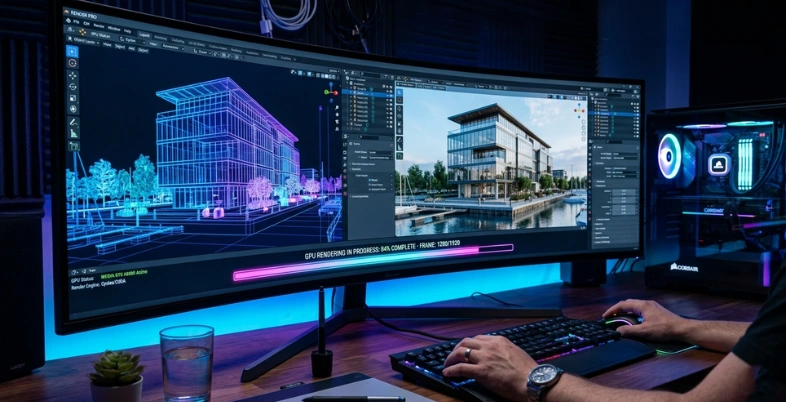
When you enter this world, you bring to life all the wildest ideas, like a simple drawing of a dream house appearing alive with all the sunshine and a beautiful background, or a sci-fi device that seems like it is about to take flight right off the screen. That is the magic of 3D Rendering Software, the powerful orchestras which provide digital designs with the look of light, shadows, and textures that are inconceivable.
Whether you are an architect envisioning large-scale projects, a game developer making the appropriate worlds, or a hobbyist tinkering with discovering awesome pictures, the correct software will jump-start the creative process without the unfavorable features. It is possible to find the appropriate 3D rendering tool not only in this blog: the best of the best in 2026—easy, feature-rich, beginner-friendly to expert-level—but also make your own.
What is 3D Rendering Software?
The software used to create 3D rendering is a special computer program, often referred to as a 3D rendering tool, used to transform three-dimensional models into computer-generated two-dimensional pictures or animations using light, material, textures, shadows, and reflection and refraction effects simulated by the software.
It is a final step employed in 3D processes – once models have been created, textures and lighting have been created – which involves performing complicated computations either through a computer CPU or a graphics card to generate realistic images used in fields such as architecture, video games, film, product design, and advertisements. Popular ones are Blender, Autodesk Arnold, V-Ray, and KeyShot which allow designers to create designs that are visually realistic prior to production.
Why Choosing the Right Product Rendering Software Matters?
The choice of the proper product rendering software and 3D rendering tool is highly critical to serious designers and digital marketers who create quality images embraced in e-commerce, marketing, or product development. It directly affects the efficiency, the quality of output, and the performance of the business in competitive markets.
Enhances Visual Appeal:
- The quality attributes are the attention to copying, light actualism, and texture, which influence 77 percent of the buying decisions made by consumers when using details.
- Conforms to brand aesthetics to ensure emotional responses and evoke trust in audiences.
Boosts Efficiency
- The applications like KeyShot are easily customized and offer real-time rendering that provides less time waiting and more time of iterating in the process of developing a product.
- Live contact with CAD or the existing working process decreases the training of busy teams.
Ensures Compatibility
- Optimize your 3D programs (e.g., Revit, Blender) to no longer be confined to a complex project or scene.
- Supports different needs like photorealism, e-commerce, or animation graphics without any extra fees.
Improves Cost-Effectiveness
- Divides is a product with speed and price, which offers professional performance without the expenditure of money on features they do not require.
- Success history on the basis of portfolio and reviews comes in handy when choosing viable alternatives that grow with an increase in business.
List of 12 Best 3d rendering software
1. V-Ray
website :https://www.chaos.com/vray
V-Ray is a commercial 3D Rendering Software created by Chaos and is known for its photorealistic and physically based rendering, widely used in fields such as architecture, film, product design, and game development. It supports high-quality ray tracing, global illumination, and hybrid CPU/GPU rendering to make lighting, materials, and environments appear as realistic as possible. It is also fully compatible with many 3D applications such as 3ds Max, Rhino, SketchUp, Maya, and Cinema 4D.
Key Features
- Physically factual global illumination and ray tracing allow realistic lighting and shadows.
- Rapidly render using Hybrid CPU and GPU.
- HDRI environment lighting and sun/sky system supports various types of lights.
- Top-notch simulation, caustics, and denoising.
- Light Mix: post-render light editing without re-rendering lights.
- Support render includes things like ID mattes, depth passes, and motion blur.
- Integration of Chaos solutions like Cosmos library, Phoenix simulations, and Cloud rendering.
Pricing
- V-Ray Solo: US $45/month
- V-Ray Premium: US $59/month
- Anima:; US $59/month
2. Autodesk Arnold
Website: https://www.autodesk.com/products/arnold/overview
Autodesk Arnold is a physically based, high-performance Monte Carlo ray-tracing autorender, deployed in film and TV production and to design high-end 3D Animation Software pipelines to produce predictable and photoreal images with a rich supply of complex effects, volume effects, and naturalist lighting.
It is an intimately related add-on to the large DCC packages such as Maya, 3ds Max, Houdini, and Cinema 4D, and can also be rendered on either CPU or GPU, such that an artist does not have to leave their host application to do so.
Key features:
- State of the art Monte Carlo ray-tracing to production-level photorealistic renders.
- Live feedback interactive production in Maya, 3ds Max, Houdini, among others.
- Hybrid CPU and GPU Flexibility and speed in viewing big scenes.
- SSS of real skin, wax, and translucent materials that are high-performance.
- Hair and fur primitives are ray-traced and credit-efficient with sophisticated character beauty.
- Volumetric smoke, clouds, mist, fire, and pyroclastic.
- 3D motion blur, including deformations and rotation that are mixed with shadows, GI, and reflections.
- Native Alembic support of direct rendering of Alembic sequences.
- Physically based Shading system (Standard Surface, etc.) to be in a position to predict materials and make them consistent.
- Effort in optimization and diagnostics of API and statistics tools to optimize the render performance.
- Python and C++ APIs of pipeline integration and scripting, and USD/OpenVDB workflow support.
Price
- Single-user annual payment stands at around $430/year
- Annual subscription:$36/month. Paid annually.
- Monthly subscription:$55 Paid monthly
3. Blender (Cycles & Eevee)
Website: https://blender.org.
Blender is a free, open-source 3D software, which is built in two default render engines, part of Eevee and Cycles. Path-tracing, physically-based Cycles engine, which enables the effect of natural light to generate a very realistic image, would be a more sensible solution in such a scenario, when high-quality renders, VFX, as well as quick animation that also appears high-quality are required, whilst Eevee is a rasterization-based engine, and is also real-time.
Key features:
- Cycles (high fidelity render engine)
- Physical materials (PBR) and realistic lighting to achieve real results.
- Path tracing that facilitates global illumination, caustics, subsurface scattering, volumetrics and full bouncing control of light.
- Both the CPU and the GPU rendering are high quality, as it is done with high-quality samples and high-quality denoising.
- Full support of blender node based shaders, render layers, and compositor.
- Various other engines, including Eevee (real-time render engine).
- On-the-fly display of the viewport to provide on-the-fly feedback in the modeling process, texturing, and animation.
- Screen-space reflection, ambient occlusion, bloom, depth of field, cinematic effects, and motion blur.
- Fast and light, can be applied even to a mini computer and laptops.
- Identical shader-node architecture as Cycles, thereby supporting materials to be previewed, and can be engine-compatible in most cases.
Price
- Blender is open and available at no cost; it does not have a price or a subscription cost.
4. Lumion

Website: https://lumion.com
Lumion is a 3D architecture visualization program in real time that allows designers, planners, and architects to realize CAD or BIM models without the need to switch to a heavy rendering program to create realistic still images, animations, 3D panoramas, and a realistic environment. It runs directly on the graphics card, is compatible with other popular software, including Revit, SketchUp, AutoCAD, and ArchiCAD, and is meant to be uncomplicated so that the storyteller can focus on design and not on rendering environments.
Key features:
- Immediate creation of the graphics and preview of the changes made to the material, lights, and objects in the scene.
- LiveSync CAD/BIM (Revit, SketchUp, etc.) to synchronize the models.
- Huge dedicated investment of models, material, vegetation, people, automobiles, and props to the scene inventory.
- Good quality lighting, weather, sky, and season effects.
- With the help of 3D rendering, animations, 360 tour, and virtual reality.
- It is possible to strategically use these professional aspects (depth of field, reflections, bloom, and color grading) and style options by artists.
- Upscaling of the image (in Lumion Pro) with the assistance of AI to 8K.
Price :
- Lumion View: $199/year
- Lumion Pro: $999 / year
- Lumion Studio:$1,299 per year
5. Enscape

Website: https:enscape3d.com.
Enscape is a commercial 3D Rendering Software and real-time system to render and visualize the design and is suggested to architects, interior designers, and AEC (Architecture, Engineering, Construction) professionals, and is compatible with most design software, including Revit, SketchUp, Rhino, Archicad, and Vectorworks.
It converts 3D representations to real-time walkthroughs of photorealism, virtual reality, and interactive presentation, enabling the user to edit the materials, lighting, and elements in real-time, without altering their native modeling software, which reduces the rate of design iteration and client communication considerably.
Key Features
- Live architecture with live synchronisation to CAD/BIM to live update of design.
- Virtual reality (VR) supports headsets such as Oculus Rift and Vive.
- Material and asset libraries that can be customized in terms of location, modified, and display real-time reflections.
- Video export, 360-degree panoramas, batch processing, and standalone programs (.exe or web).
- Context of the site through OpenStreetMap, orthographic views, and through NVIDIA DLSS to boost performance.
- Height map and video texture editors, with the ability to edit many assets at once.
Pricing
- Enscape Solo: US $47/month
- Enscape Premium: US $52/month
- ArchDesign Collection: US $94 /month
Suggested Read :
6. OctaneRender
website: https://home.otoy.com/render/octane-render/
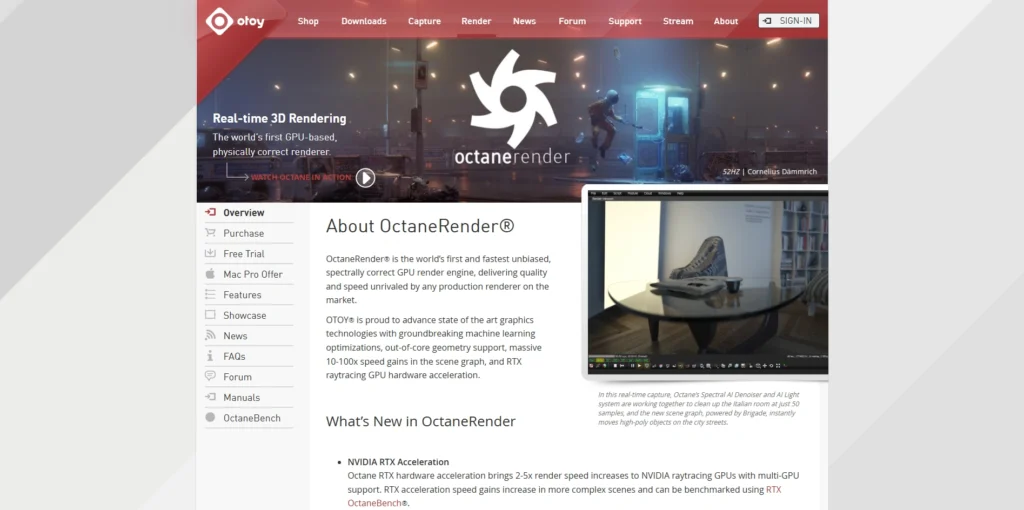
The OctaneRender is an impartial, physically-based, leading-edge render engine for the GPU developed by OTOY, and employed in the development of high-end 3D content in fields like film, VFX, product design, architecture, and game development.
It can be used to generate real-time, photorealistic results with spectral light transport, with full capability of modern GPUs (using either NVIDIA CUDA or Apple Metal API), and is 10-100x faster than conventional CPU-based ray tracers.OctaneRender is based on Monte Carlo path tracing, unlike scanline or rasterization engines, making it as accurate as possible, and modeling the real-world behavior of light, including spectral rendering.
Key Features
- Accelerated graphics rendering is 10-50 times faster than CPU engines, and multi-GPU capability.
- Objective and straightforward lighting modes such as ambient occlusion, subsurface scattering (SSS), complex IOR, and chromatic dispersion of realistic material.
- Such higher-level procedural tools as Vectron and Spectron of infinity geometry/volumetric generation, layered materials, and node-based shading.
- Out-of-core geometry/textures, denoiser, motion blur, volume rendering, HDRI environments, and AI-assisted viewport rendering are some of the features.
- Render passes, deep image support, network rendering, application integration with Unity, After Effects, Nuke, and Photoshop.
Pricing
- Annual subscription:$19.99 /month
7. Redshift
Website: https://aws.amazon.com/redshift/
Amazon Redshift is a fully managed, petabyte-scale data warehouse service in Amazon Web Services (AWS) that offers support for high-performance analytics of large data. It also has the foundation of massively parallel processing (MPP) architecture and column storage, and optimizes data compression to execute complex SQL queries at very high speeds across distributed compute nodes.
In addition, when integrated with visualization pipelines and design workflows, it can support data processing needs behind advanced visualization platforms and 3D rendering tool environments used for large-scale projects. This makes it suitable for business intelligence, reporting, and data lake analytics without having to deal with the underlying infrastructure.
Key Features
- Massively parallel processing (MPP) querying of gigabyte to exabyte data volumes.
- Columns that will be compressed and shrunk to a zone map, to reduce I/O and maximize efficiency.
- Automatic fault protection, high availability Replication of Data re-copying, and node replacement.
- Scales to 16 petabytes per cluster, and is also able to scale to peak loads at the same time.
- Strong security through encryption, VPC isolation, IAM mix, and row/column access controls.
- Flexible data query and piping by interoperability with SQL client, BI tools,s and AWS services.
Pricing:
- Pay-as-you-go pricing: Amazon Redshift does not require an upfront fee and charges per second based on the compute node type.
- On-Demand pricing: Starts from $0.25 to $13.04 per node-hour, depending on the node type and region.
- Reserved instances: Offer up to 75% discount when committing to 1–3 year plans.
- Serverless option: Pricing is based on query usage, measured in RPU-hours, ranging from $0.36 to $3.29.
8. Unreal Engine (Path Tracer)
Website: https://www.unrealengine.com/en-US/
Path Tracer in Unreal Engine: Unreal Engine Path Tracer is a progressive 3D Rendering Software feature that is accelerated by hardware and generates photorealistic imagery, rendering physically correct global illumination, reflection, refraction, and shadows, and bridging the gap between offline renderers like those in film production and real-time renderers.
It takes advantage of the inbuilt ray tracing architecture of Unreal with an extremely easy setup to allow artists to produce high-quality, bias-free renders either in-viewport or via tools like Movie Render Queue, which is useful in final shots and in ground truth comparisons, as well as cinematic output with no further software.
Key Features:
- Generates high-quality and physically realistic renders along with high-quality lighting, materials, and effects, e.g., caustics and rough transmission.
- Light installation; it does not require being configured with additional geometry and materials of the scene.
- Makes bounces of reflections/refractions infinite, tracing of paths of shadows, and global light of all materials.
- Cooperates with the complete integration to the Sequencer, movie render Queue to offer film/TV quality results.
- Control parameters like Max Bounces, Samples per pixel (to eliminate noise), and Filter Width (to eliminate anti-aliasing) can be changed.
- The hardware that can be converged very fast is the NVIDIA RTX GPU and Windows 10+.
Pricing:
- Unreal Engine is open-source and available for download and use for content creation.
- It includes the Path Tracer as a built-in feature.
- Epic Games charges a 5% royalty on gross revenue after the first $1 million USD per product.
- The Path Tracer does not require any additional fee and is included with Unreal Engine.
9. D5 Render

website: https://www.d5render.com
D5 Render is a real-time, ray-tracing software primarily utilized by architects, interior designers, and landscape professionals that can be used to visualize 3D objects in a photorealistic way with real-time visualization of changes in lighting, material,s or geometry.
It can be used with large-scale GPU technologies such as global lights, path tracing, and AI technologies when denoising and automating scenes, and is readily compatible with other major modeling software, including SketchUp, Revit, Rhino, and Blender to help streamline the process of creating a design as well as the end product, like high-resolution images, animation, and VR experiences.
Key Features:
- Adaptive sampling Real-time global light (GI) with noise-free and responsive light change.
- Computer-generated intelligence, including denoising, super-resolution up to 16K, and automatically generated textures.
- Thousands of drag-and-drop models, vegetation, and PBR materials.
- Live sync supports the importation of files to the design software directly without converting files.
- Walkthroughs, camera tracks, 360 deg panoramic animation features, and high-speed 4K exports.
- Browser-based exploration Procedural landscaping, scattering, and 3D Gaussian Splatting.
- Team working, like sharing scenes and control of layers of large projects.
Pricing:
- Free Plan: D5 Render offers a free version that includes basic features suitable for beginners and simple projects.
- Pro Plan: Provides advanced AI tools, higher rendering capabilities, and additional professional features.
- Team Plan: Designed for collaborative work with shared resources and enhanced workflow tools.
- Pricing: Annual subscriptions for the Pro plan may cost around $360 per year, depending on region, promotions, or discounts.
- Student Discounts: Students may receive special discounted pricing on Pro subscriptions.
10. Chaos Corona

Website: https://www.chaos.com/corona
Chaos Corona is a photorealistic 3D Rendering Software application that was developed by Chaos and previously known as Corona Renderer. The initial version of which was designed in 2008, and its main goal was to ensure ease of use for users, together with the ability to visualize architecture and create high-quality CGI.
It also offers a CPU-based path tracing renderer, with biased (faster with precomputations) and unbiased rendering modes, offering predictable and physically accurate lighting, materials, and caustics with no extensive tweaking, and compatible with applications such as 3ds Max and Cinema 4D.
Key Features:
- CPU-based rendering with biased/unbiased, progressive/bucket, and 4K cache to provide consistent results.
- Interactive rendering, distributed rendering, and real-time viewport preview to facilitate workflow efficiency.
- Chaos Cosmos library of assets, such as models, HDRIs, materials, and Chaos Scans; contains AI Material Generator and procedural generators such as scatter clusters.
- Physical camera, fancy lighting, materials editor, and the AI-driven denoising/enhancements (e.g., toon shading, night sky, image upscaling).
- Adds graphics card-enhanced animations and plugins such as the Chaos Phoenix to simulators.
Pricing:
- Corona Solo: US $34/month
- Corona Premium: US $42/month
- Corona edition: US $78/month
11. Twinmotion
Website: https://www.twinmotion.com
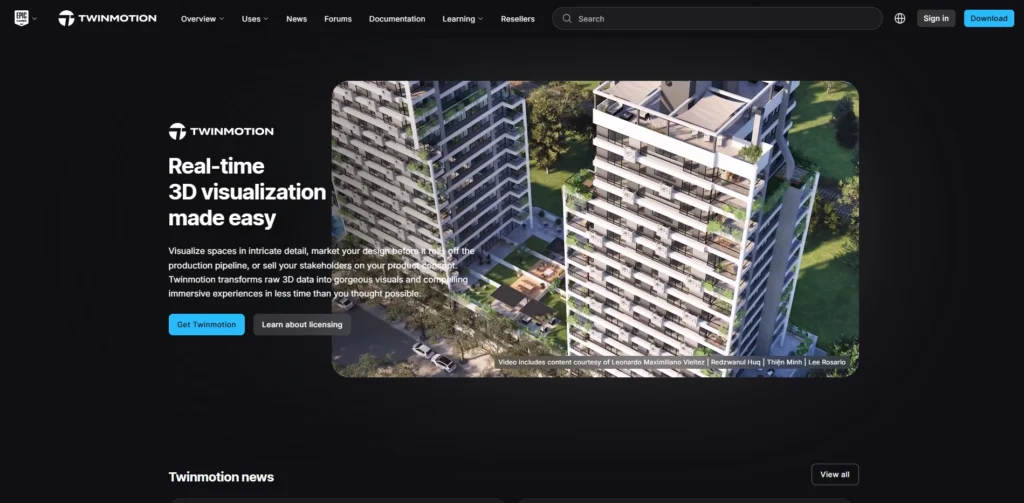
This is an efficient, real-time 3D visualization and immersive rendering application, Twinmotion, developed by Epic Games, based on the Unreal Engine technology that enables architects, interior designers, and landscape designers, urban planners, movie-makers and game developers to rapidly import 3D models created in applications like Revit, SketchUp, Rhino, or Archicad or FBX files into beautiful and photorealistic environments, interactive walkthroughs, panoramas, 360 virtual reality video, and presentations with an extremely user-friendly,
Key Features:
- Unreal Engine enables real-time visualization of real-time previews of created alterations.
- Massive asset lists such as furniture, vehicles, vegetation, characters, and mobile objects such as crowds and traffic.
- Synchronization/ Importation to CAD/ BIM software (Revit, SketchUp, Rhino, ArchiCAD, etc.)
- Simple simulation Advanced simulation, Weather, lighting (and Lum global illumination), wind, water, and animations.
- VR/AR experience tools, filmback, deterministic, and parenting animators of intricate scenes.
- Drag and drop interface, which is simple to work with and simple to learn.
Pricing
- Free Access: No subscription fee for individuals, students, educators, hobbyists, and businesses with annual revenue under $1 million USD.
- Standalone Commercial License: $445 USD per seat per year.
- Unreal Subscription Plan: $1,850 USD per year, which includes additional tools and features.
- Pricing Variations: Prices may vary depending on the region or reseller.
12. Iray
Website: https://www.nvidia.com/en-us/design-visualization/iray/
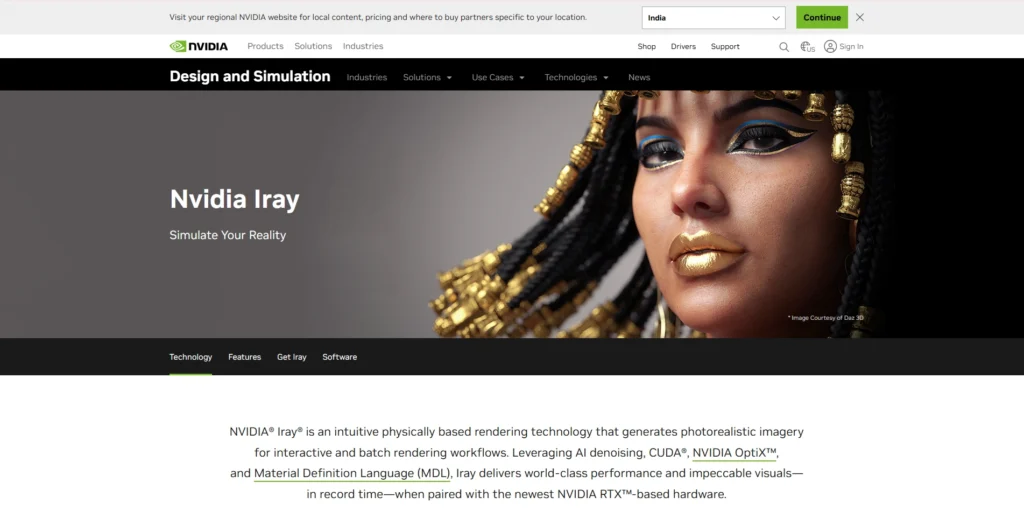
The NVIDIA Iray is a physically based rendering (PBR) engine that is used to create photorealistic images and animations of 3D models, which models the general behaviour of light and describes the behaviour of light with a high degree of accuracy.
Iray takes physics-based algorithms which are not only hyperfast but also unbiased and could be applied to generate complex lighting effects (including global illumination, reflection, refraction, subsurface scattering and caustics) and could be applied in the final image making it popular in design, architecture, automotive visualization, film, product rendering and plug-in in applications like Autodesk Maya, 3ds Max, Blender (with plug-ins), Daz Studio and Omniverse, making it a powerful 3D Rendering Software solution for professionals.
Key Features:
- The impacts of the lights of the world on the real world, including the real-world reflections, refractions, and caustics.
- Denoising of end renders and more interactive previewing using AI.
- MDL and confirmed material libraries.
- Software GPUs and real-time Hardware Ray-tracing hardware.
- Immersive, 360-degree, and panoramic snapshots incorporated in VR.
- Live feedback, interactive output, and spurring image enhancement.
Pricing
- Iray can be used with compatible NVIDIA GPUs and works with supported software such as Daz Studio.
- Local licenses start at approximately $295 USD.
- Custom licensing portfolios may be offered by vendors depending on usage needs.
Comparison Table
| Software | Price | Free Plan | Best For |
| V-Ray | Solo: $45/mo; Premium: $59/mo | No | Photorealistic architecture, film, product design |
| Autodesk Arnold | $36/mo (annual); $55/mo | No | Film/TV production, complex animations |
| Blender (Cycles & Eevee) | Free | Yes (full) | High-quality renders, VFX, versatile use |
| Lumion | View: $199/yr; Pro: $999/yr | No | Architectural visualization, real-time previews |
| Enscape | Solo: $47/mo; Premium: $52/mo | No | Architects, real-time walkthroughs, VR |
| OctaneRender | $19.99/mo (annual) | No | GPU-accelerated film, VFX, product design |
| Redshift | Pay-as-you-go (from $0.25/node-hr) | No | Data-heavy analytics |
| Unreal Engine (Path Tracer) | Free (5% royalty over $1M) | Yes (full) | Photorealistic cinematics, real-time best-3d-rendering-software.docx |
| D5 Render | Free basic; Pro: ~$360/yr | Yes (basic) | Architects, real-time ray-tracing |
| Chaos Corona | Solo: $34/mo; Premium: $42/mo | No | Photorealistic architecture CGI |
| Twinmotion | Free (<$1M revenue); $445+/yr | Yes (indie) | Architects, immersive real-time viz |
| Iray (NVIDIA) | From $295 (licenses) | No | Physically-based design, VR panoramas |
Conclusion
whether it is V-Ray due to its universal and photorealism capability, Blender due to its free functionality, Lumion/Enscape due to its ease of use, and what sort of requirement, user cost and workflow (amateur with the ability to create product images, or professional using tricky scenes) is required, will determine which 3D rendering software is most appropriate in 2026. Autodesk Arnold and Chaos Corona are said to be the most efficient in providing movie quality output with objective light but still, OctaneRender and D5 Render also utilize the power of the have gotten the opportunity to make as many iterations as a person wants to achieve insanely good results without having to go ahead and do further refinements.
Finally, begin with free software to play around with, like Blender or Twinmotion, and go to more quality software that is efficient and compatible with your CAD/BIM software, and converts conceptual ideas and transforms them into natural-like images that impress audiences.
FAQs
Q1 Does It Have The 3D Rendering Software, Which Can Be Used At Will?
A: Blender is professional, it is free, it has solutions, such as the Cycles, to create photorealistic renders, and it is a product that can be attractive to anyone, including a hobbyist, and a professional.
Q2 Which Should Be Better, GPU Rendering Or CPU Rendering?
A: GPU rendering is also comparatively faster because it is possible to carry out parallel processing, and new programs such as the Octane Render and Redshift can render more complex images fast enough.
Q3 Which Software Would You Say You Prefer To Use In Architectural Visualization?
A: An lumion or Enscape lead on the case of Archviz with real-time generation, easy compatibility with SketchUp / Revit, and realistic environments.
Q4 What Is The Cost Of The Professional 3D Rendering Software?
A: Costs depending on the type of price, Blender is free,e and an Autodesk 3ds Max or V-Ray subscription runs around 200-300/month, with most having some form of trial or a renderer executing with the help of a graphics card,d such as Corona.
Q5 Does The 3D Rendering Software Allow Opportunity Of Integrating With Other Tools?
A: The enormous majority of them, such as Enscape with Revit/Rhino or Octane with Blender/Maya, have the ability to make the modeling and animation program a part of an app coherent app workflow.
Q6 What Software Is The Most Appropriate For VFX And Animation?
A: Autodesk Maya + Arnold or Redshift can offer impressive functionality to be used in high-end VFX, whereas Blender can be used as a handy tool to implement in both film and game animation.
Q7 Which One Is Better To Use, Real-Time Or Offline Rendering?
A: Quick previews and VR: A real time solution is used, such as Unreal Engine or Twinmotion.n Final output, an offline solution that is the most photorealistic is used, such as Cycles or V-Ray.