


Email is the foundation of personal and professional communication in the current digital world. Whether it is business-related business correspondence, maintaining contact with friends and family, or just planning your day, the right email service can make a big difference in terms of productivity and online experience. There are literally too many different email providers in the market, and it can be difficult to find the one that perfectly fits your needs. Storage capacity and security measures versus user interface and integration capabilities, each email service comes with its own share of benefits.
The history of email services has been astonishing in the last 20 years. What initially began as basic text-based messaging platforms has evolved to complex platforms with advanced functionality, such as artificial intelligence support, strong security measures, effortless cloud-connectivity, and overarching productivity solutions.
What are the Best Email Providers?
Email providers are online resources that allow users to send, receive, and administer electronic messages via the internet. The services provide online mailboxes where users may save their mail and organise communications and other productivity features. The most popular email companies stand out through stable services, high levels of security, larger storage capacity, and an easy-to-use interface that supports the needs of various users.
The email services of today have developed much further than mere messaging platforms. The current market leaders incorporate calendars, cloud storage, task management, and collaborative applications into full communication systems. They use advanced algorithms to fight spam, defend against malware, and make sure that the correct messages arrive at their correct recipients. Another factor that needs to be considered when comparing the options is the storage capacity, limit of attachment, privacy policy, integrative capability, and the general user experience on both the desktop and mobile platforms.
Essential Features to Look for in the Best Email Providers
To choose an email service, it can be helpful to consider which features are the most important and to make a choice that will really be able to improve your online communication. Email providers cannot be universal, and what may suit well to one individual well may not fit the needs of another person. The two features that you ought to consider are:
- Storage Space: This is quite a large storage space, so you do not ever need to worry about deleting valuable emails or space.
- Security and Privacy: In a world where cyber threats are on the rise and different types of data breaches are common, no one can afford to compromise on security features.
- User Interface and Experience: The interface is clean and easy to use, and it is not frustrating. The most user-friendly email services have customizable layouts, keyboard shortcuts, intelligent sorting, and responsive layouts that can be used on any device.
- Integration Capabilities: The existing email should be aligned with other applications and systems that you utilise in your daily lives.
- Premium Features: Other than the basic send-and-receive, premium email offers several other features, including email templates, scheduled email delivery, read receipts, automatic filters and rules, AI-assisted email writing support, and advanced search.
Comparison Table for Best Email Providers
| Email Provider | Rating | Best Feature |
| Outlook.com | 4.7/5 | Machine learning email sorting |
| Yahoo Mail | 4.5/5 | Massive 1 TB storage capacity |
| Proton Mail | 4.8/5 | End-to-end encryption security |
| Gmail | 4.6/5 | Superior search functionality |
| iCloud Mail | 4.4/5 | Seamless Apple ecosystem integration |
| Neo | 4.5/5 | AI-powered writing assistance |
| Zoho Mail | 4.6/5 | Professional business features |
| AOL Mail | 4.3/5 | Generous storage allocation |
| Tuta | 4.7/5 | Ad-free encrypted experience |
| Mail.com | 4.2/5 | Large 30 MB attachment limits |
| Mailfence | 4.6/5 | Digital signature authentication |
Top 11 Best Email Providers
1. Outlook.com
Rating: 4.7/5
Website: outlook.com
Best Use Cases: Business professionals, Microsoft ecosystem users, productivity-focused individuals
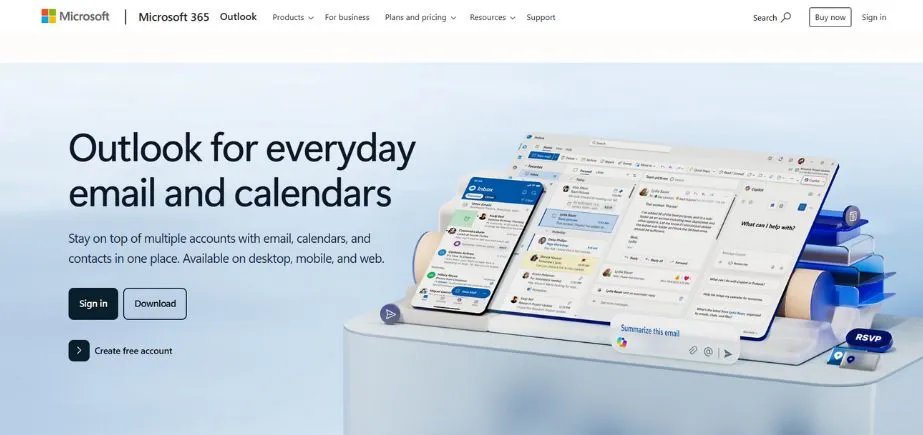
The email service of Microsoft is a testament to decades of development of their first venture the Hotmail, which was previously known as, into a complex communication service. Introduced in its present form to compete with the contemporary email services, Outlook.com is a product that integrates robust features and intelligent automation to provide an excellent user experience.
The platform uses machine learning technology to understand your communication behaviour and prioritise the messages that have the most impact, helping you stay focused on the most important correspondence as well as filter the noise. Outlook.com also has a Focused Inbox that separates the incoming messages and distinguishes them, automatically determines their importance. It is an intelligent system of sorting that learns as you use it and is constantly getting more accurate.
The service also offers 15 GB of dedicated email storage that is not shared with cloud services, and hence your mailbox will not suddenly run out of space. Outlook.com is also the best email service provider offering professional-level functionality at no subscription fee, with extensive integration throughout the Microsoft productivity suite and the ability to manage complex automation rules.
Also Read: Best CRM Software
Key Features:
- Focused Inbox sorting
- Advanced automation rules
- Microsoft suite integration
- Template creation tools
- Cross-platform compatibility
Pros:
- Intelligent email prioritisation
- Dedicated storage allocation
- Powerful automation capabilities
Cons:
- Contains advertising content
- Occasional false spam detection
- Limited third-party compatibility
Pricing: Free with 15 GB storage
2. Yahoo Mail
Rating: 4.5/5
Website: https://uk.yahoo.com/
Best Use Cases: Long-term storage needs, media-heavy communications, casual users
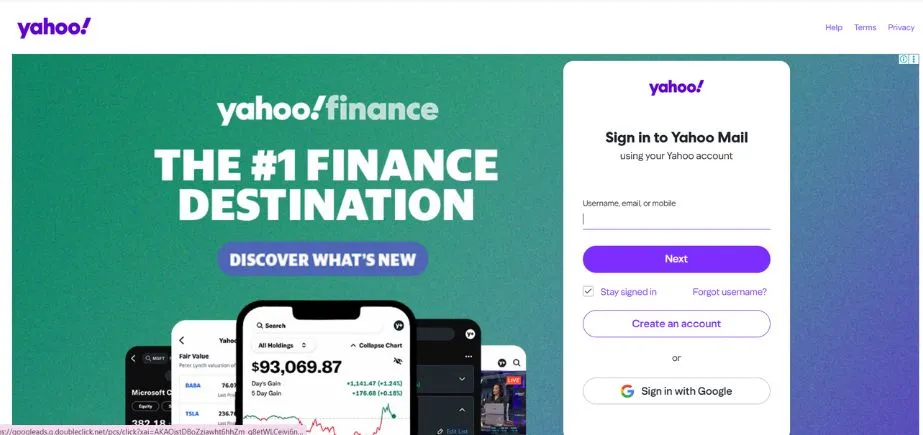
Being among the first web-based Email Providers, Yahoo Mail has managed to stay relevant by providing features that directly respond to the needs of the users in such areas as large storage and organising tools. One aspect that the platform is dramatically different in is its storage capacity. Most competitors will be counting their free storage in gigabytes, but Yahoo Mail offers an enormous 1 TB of storage, virtually removing storage issues for the vast majority of users.
Key Features:
- Terabyte storage capacity
- Views attachment filtering
- Customizable interface design
- Keyboard shortcut support
- Mobile app availability
Pros:
- Exceptional storage allocation
- Intuitive attachment organisation
- Highly customizable interface
Cons:
- Marketing advertisements present
- Historical security concerns
- Weak spam filtering
Pricing: Free with 1 TB storage; Yahoo Mail Pro removes ads for $4.99/month
3. Proton Mail
Rating: 4.8/5
Website: https://proton.me/mail
Best Use Cases: Privacy-conscious users, secure communications, sensitive information handling
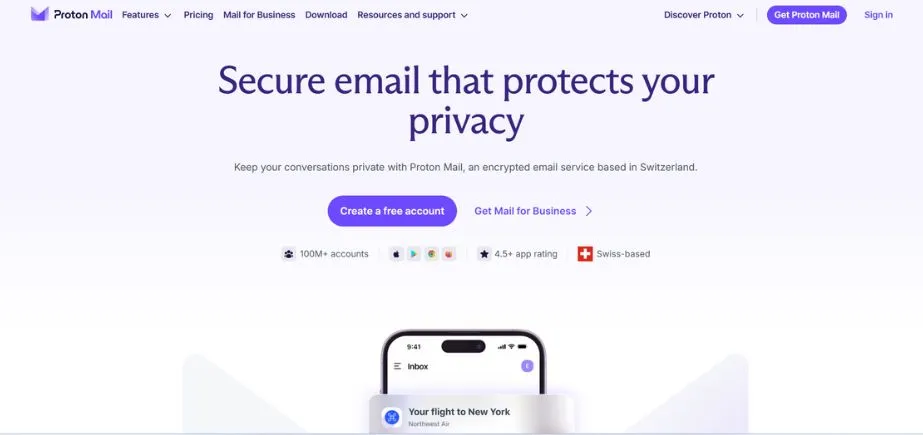
Proton Mail is the new superhero of user rights and privacy in an era when online privacy seems even more elusive. This is an email service based in Switzerland, which was designed with privacy and security as core principles and not as an afterthought. All messages exchanged using Proton Mail are client-side encrypted, which implies that your messages will be mixed up in an unrecognisable manner before leaving your computer and can only be decrypted by the recipient. This design guarantees that not even troton Mail itself is capable of reading the contents of your messages.
Key Features:
- End-to-end message encryption
- Tracking pixel blocking
- Password-protected emails
- Comprehensive search functionality
- Migration assistance tools
Pros:
- Uncompromising privacy protection
- Client-side encryption standard
- Advanced security options
Cons:
- No third-party integration
- Limited free storage
- Steeper learning curve
Pricing: Free with 1 GB storage
Don’t Miss: Top AI Plagiarism Checker
4. Gmail

Rating: 4.6/5
Website: https://workspace.google.com/intl/en_in/gmail/
Best Use Cases: Google ecosystem users, productivity enthusiasts, collaborative work environments
Gmail, or Google Mail, was introduced by invitation in 2004 but has since taken over the email market with a total of over 1.2 billion users distributed worldwide. It is this massive rate of adoption owing to the simplicity, power, and integration of Gmail in the broader service system of Google. The site is searchable, and as a result, the search experience uses Google to ensure that specific messages are visible to users on first glimpse, regardless of their age or the length of time they have lingered in the inbox.
Key Features:
- Superior search capabilities
- Google ecosystem integration
- Email template creation
- Multiple signature support
- Keyboard shortcut library
Pros:
- Powerful search function
- Seamless Google integration
- Polished mobile experience
Cons:
- Shared storage allocation
- Inconsistent spam filtering
- Privacy concerns
Pricing: Free with 15 GB storage
5. iCloud Mail
Rating: 4.4/5
Website: https://www.icloud.com/mail
Best Use Cases: Apple device owners, iOS ecosystem users, Mac enthusiasts
Email offering of Apple is closely related to the ecosystem of hardware and software of the company, and its experience is most visible when it is used on iPhone, iPad, and Mac devices, where it is perfectly synchronised and consistent, despite what device you are using. Creating an address with the suffix, which is iCloud.com, happens in seconds when you are using any Apple equipment, and once it is established, your email, settings, and preferences follow you across all of your Apple equipment.
Key Features:
- Apple ecosystem synchronisation
- Round-the-clock support
- One-click unsubscribe option
- Advanced search tools
- Cross-device consistency
Pros:
- Excellent Apple integration
- Superior customer support
- Simple user experience
Cons:
- Apple-exclusive functionality
- Limited organisation features
- Modest storage allocation
Pricing: Free with 5 GB storage
Also read: Best Cold Email Software
6. Neo

Rating: 4.5/5
Website: https://www.neo.space/
Best Use Cases: Small businesses, entrepreneurs, personal branding, freelancers
Neo is also branded as the Email Providers provider that provides small businesses and entrepreneurs with professional email communication features at the complexity and price levels of an enterprise. The best thing about the platform is that it has the Smart Write AI assistant, which is a revolution in email writing as it composes entire messages using a simple description about what you need to say, the tone you want to use, and the length you want to communicate. This technology saves a lot of time in the creation of professional emails, which will enable the business owners to concentrate on the main activities and still uphold professional communication standards.
Key Features:
- AI-powered email composition
- Multi-account management interface
- Schedule sending capability
- Read receipt tracking
- Follow-up reminder system
Pros:
- Advanced AI assistance
- Professional branding tools
- Business-focused feature set
Cons:
- No permanent free plan
- Offline functionality absent
- Tiered feature restrictions
Pricing: Plan starts at $2.49/month
7. Zoho Mail
Rating: 4.6/5
Website: https://www.zoho.com/mail/
Best Use Cases: Small businesses, professional communications, security-focused users
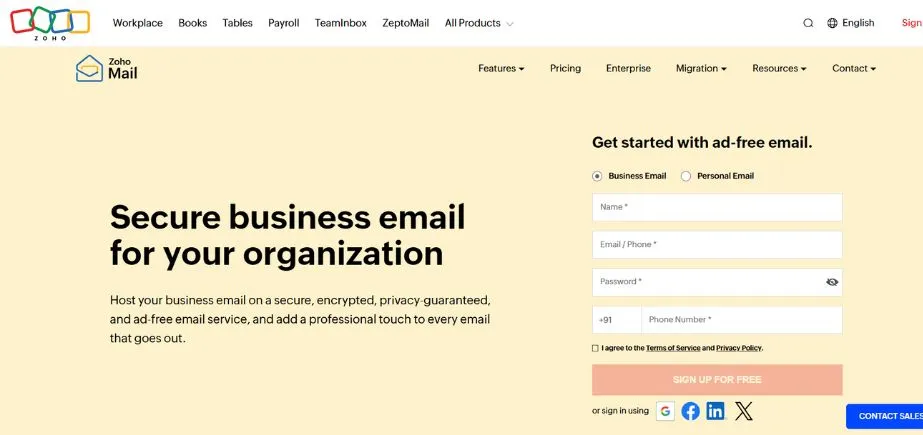
Zoho Mail, which is a component of the entire cloud-based productivity package offered by Zoho, provides small businesses and professionals with enterprise-quality Email Providers. The service is, by itself, extremely easy to acquire a dedicated domain email address, unlike consumer-oriented services, which are focused on their own domain names. Such an ability is enough to impress business owners who realise that professional communication demands a branded email address instead of a generic free service identifier.
Key Features:
- Custom domain support
- Multi-layered security infrastructure
- Productivity suite integration
- Calendar and task management
- Mobile application access
Pros:
- Robust security measures
- Professional domain options
- Comprehensive organisation tools
Cons:
- Modest free storage
- Learning curve present
- Limited consumer features
Pricing: Free for up to 5 users with 5 GB storage
8. AOL Mail

Rating: 4.3/5
Website: https://mail.aol.com/
Best Use Cases: Long-term archiving, multiple inbox management, straightforward communication
The legacy of AOL Mail is that it is one of the first email services on the internet, and despite the volume of its mainstream usage being less than it was in the 1990s, it is still a reliable option among users who do not need any more complexity than the service provides. The service also provides indispensable email services such as organization of inbox organisation, anti-spam filtering, and allows the creation of automated rules and filters to manage incoming messages. Although it might not be equipped with hot features like other newcomers, AOL Mail has a solid mastery of the basic communication demands.
Key Features:
- Terabyte storage provision
- Automated filtering rules
- Spam protection system
- Straightforward navigation interface
- Multi-account consolidation support
Pros:
- Massive storage capacity
- Essential security features
- Simple interface design
Cons:
- Limited advanced capabilities
- No AI integration
- Dated user experience
Pricing: Free with 1 TB storage
9. Mail.com
Rating: 4.2/5
Website: https://www.mail.com/
Best Use Cases: Basic email needs, large attachment handling, casual users
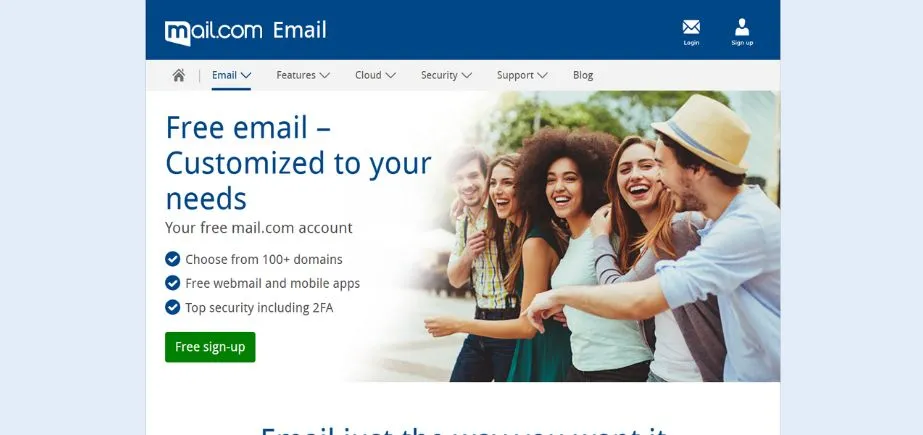
Mail.com is targeted at customers who do not want to spend money to get enhanced email features and who use basic email services without buying a dedicated domain. The service is oriented to provide basic email functions, i.e., sending, receiving, and basic organisation of email, without the complexity or sophisticated tools that power users may desire. This ease of use will ease the use of Mail.com by users who are not as techno-savvy as those who need email to simply operate without going through the complex environment, as well as mastering the advanced capabilities of those environments.
Key Features:
- Large attachment capacity
- Integrated calendar system
- Cloud storage inclusion
- Basic filtering options
- Free domain choices
Pros:
- Generous attachment limits
- No-frills interface
- Multiple domain options
Cons:
- Weak spam protection
- Heavy advertising presence
- Security vulnerability history
Pricing: Free with 65 GB storage
Discover more: Best AI Email Writer tools
10. Tuta
Rating: 4.7/5
Website: https://tuta.com/
Best Use Cases: Privacy advocates, ad-free experience seekers, security-conscious users
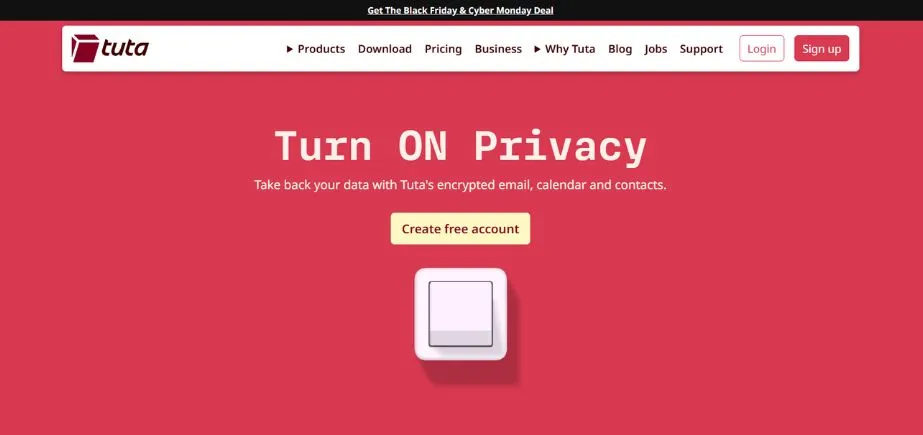
The uncompromising attitude to user privacy and security stands out as Tuta commits to it to a deeper extent than other industry players. Most of the free email providers earn their living by airing advertisements, but Tuta is doing the opposite by providing an advertisement-free experience during the initial days. This type of business model makes sure that you are not distracted by marketing messages and promotional features integrated into the interface all the time, but instead, you stay focused on your communications.
Key Features:
- Complete ad-free experience
- Dual encryption methodology
- Calendar and contact encryption
- Tracking prevention system
- Privacy-first architecture
Pros:
- Exceptional security measures
- No advertising distractions
- Comprehensive encryption coverage
Cons:
- Limited storage capacity
- No AI functionality
- Smaller feature set
Pricing: Free with 1 GB storage
11. Mailfence

Rating: 4.6/5
Website: https://mailfence.com/
Best Use Cases: Secure communications, professional authentication, privacy-focused users
Mailfence is aimed at professionals and other people whose communication integrity and security are of utmost importance. The service is a clean and secure place of sensitive correspondence using end-to-end encryption without tracking and advertising. The key distinguishing feature of Mailfence over its security-oriented competitors is that it supports digital signature functionality, enabling users to sign their emails cryptographically as a sign of authenticity and verification of origins.
Key Features:
- Digital signature authentication
- End-to-end encryption
- Integrated calendar system
- Document cloud storage
- Contact list management
Pros:
- Advanced security infrastructure
- Authentication verification system
- No tracking or ads
Cons:
- Very limited storage
- Basic feature set
- Storage management required
Pricing: Free with 500 MB email + 500 MB document storage
How to Choose the Best Email Providers
The choice of the best Email Providers must be made with serious regard to your needs and pattern of use. With all these good choices you have, by getting to know which ones are most important to your circumstances, you will be able to find the best one. The following are some of the considerations that will guide you to make a good decision:
- Test Your Storage Needs: Determine the amount of storage you actually need on the basis of your emailing patterns. In case you get big attachments regularly, have a huge email history, or just never want to get rid of a message, then the focus should be on providers that have terabyte-scale storage, such as Yahoo Mail or AOL Mail.
- Determine the importance of Privacy Protection and security features: How important is privacy protection to you, and security features?
- Integration needs to be considered: Take a look at what other tools and platforms you frequent. In case you are already within the Google ecosystem and use Google Drive, Google Docs.
- Study Feature Requirements: What features do you need on top of basic email functionality? Do you require an AI writing software, like that which is provided by Neo? Is there an advantage of high automation regulations in regulating high volumes of emails?
- Test User Experience on Multiple Devices: You are likely to be using email across a range of devices, and you will want to know how well each provider works with desktop computers, smartphones, and tablets..
Conclusion
Choosing Email Providers between the best ones is a grave one, as it dictates your daily life in the digital realm, whether through business or communicating with friends and family, or business. All eleven services discussed in this ultimate guide introduce something new to the list, with Gmail and its search engine capabilities and integrations with other systems, Proton Mail and its uncompromising privacy measures, Yahoo Mail and its terabyte storage, and Neo and its AI-assisted writing. To help you choose the service that best fits your communication style and priorities, knowing your specifics (needs), storage capacity, security needs, integration preferences, and feature expectations will help you determine the best service for you.
Artificial intelligence, security, and user experience design are constantly changing in the email industry. What will not go away is the original intent of the email in modern communications. You require a giant storage space, impenetrable security, or real-time phone-to-phone communication, or business-grade capabilities; the era of email service providers has been able to offer features to accommodate virtually any conceivable purpose.
Frequently Asked Questions
Q1: Which Email Providers has the most free storage space
A: Yahoo Mail and AOL Mail allow 1 TB of free storage space, much more than any other free email service. This huge allocation simply removes storage problems for most users.
Q2: Which email is the safest one regarding privacy-sensitive customers?
A: The best thing about Proton Mail, Tuta, and Mailfence is their outstanding security features that include end-to-end encryption and no tracking. Proton Mail has gained recognition due to its high level of security with da esign the easy-to-use design.
Q3: Does it support a personal domain in the free email services?
A: Both Zoho Mail and Neo include custom domain email addresses on their free or entry-level plans, making them both useful to small businesses and professionals who need to have branded email messages.
Q4: What is the best email provider to use with Apple?
A: iCloud Mail itself is an element of the Apple ecosystem, being fully compatible with the iPhone, iPad, and Mac platforms, as well as having excellent customer support in comparison with other free services.
Q5: Which email providers do not show advertisements?
A: Yes, Proton email, Tuta, a nd Mailfence are free with no advertisements, even in their free plans, because they put their users and privacy first and advertising second.
Continue reading: Best Email Marketing Tools