
Productivity in the modern hectic digital world is no longer about working harder but smarter. Be it a lone freelancer, a startup or even a large organization, cloud based productivity apps have totally revolutionized the way teams interact, work on projects and also communicate in real time. The days when one has to e-mail files back and forth or one is bound to one desktop are gone. Using cloud based productivity applications, your whole workstation goes with you – across platforms, time zones, and borders.
The tools are in demand like crazy since 2020, and in 2026, the market is more competitive and feature-rich than ever. Ranging between AI-driven document editing to intelligent task automation, the current cloud based productivity applications have features that can neither be imagined nor did they exist before. We have selected the top 10 cloud based productivity applications in 2026 in this guide to work smarter, collaborate freely and realize more, anywhere on the planet.
What Is a Cloud Based Productivity App?
A cloud based productivity apps is a software that is hosted on remote servers and accessed using the internet on a browser or through a mobile application – no intensive installation is necessary. Rather than having all the data stored on your computer, it is all stored in the cloud, and can therefore be accessed anywhere, anytime, on any computer.
The apps are very diverse and cover many functions such as document creation, project management, team communication, file storage and collaboration all aimed at ensuring individuals and teams better accomplish much more and faster.
Key Benefits of Cloud Based Productivity Software
- Anytime, Anywhere Access: Work anywhere, anytime, as long as there is an internet connection, regardless of the device being used.
- Collaboration (in real time): Two or more users can work on the same document or project without versioning.
- Automatic Updates: Software updates run in the background, so you always have the latest features without installing them manually.
- Scalability: Scale easily with increases or decreases in team size and business requirements, without modifying expensive infrastructure.
- Cost Efficiency: The majority of cloud tools are based on cheap subscription plans, which do not require expensive hardware or other IT maintenance.
- Improved security: Major platforms will provide enterprise-level encryption, two-factor authentication, and frequent data backup to ensure your work is safe.
Categories of Cloud Based Productivity Tools
1. Document & Office Productivity Suites
They enable users to produce, edit, and share documents, spreadsheets, and presentations in real-time. Google Workspace and Microsoft 365 have substituted the traditional desktop office software with an all-cloud-powered alternative that can enable smooth collaboration of a team.
2. Project & Task Management Tools
Applications such as Asana, Trello, and ClickUp help teams plan, assign, track, and complete tasks effectively. They provide visual dashboards, timelines, and workflow automation to make sure that all projects are on schedule and that a single project does not slip through the cracks.
3. Team Communication & Collaboration
The internal communication is also innovated by such apps as Slack when the messy email messages are substituted by channels, instant messaging, and integration with hundreds of other tools that help to facilitate the communication in a team faster and more transparently.
4. Cloud Storage & File Sharing
Services that enable teams to store files, access, and share them anywhere in a secure way. This category of tools contains significant documents and media, always available and backed up, so they can be shared with internal or external collaborators.
Comparison Table: 10 Best Cloud Based Productivity Apps in 2026
| Name | Key Features | Pricing | Rating | Website |
| Google Workspace | Docs, Sheets, Meet, Drive | From $6/user/month | 4.8/5 | https://workspace.google.com/ |
| Microsoft 365 | Word, Excel, Teams, OneDrive | From $6/user/month | 4.7/5 | https://www.microsoft.com/en-us/microsoft-365 |
| Zoho Workplace | Mail, Writer, Cliq, WorkDrive | From $3/user/month | 4.5/5 | https://www.zoho.com/workplace/ |
| Slack | Channels, Huddles, Automations | Free; Paid from $7.25/month | 4.7/5 | https://slack.com/ |
| Asana | Tasks, Timelines, Goals | Free; Paid from $10.99/month | 4.6/5 | https://asana.com/ |
| Trello | Boards, Cards, Butler AI | Free; Paid from $5/user/month | 4.5/5 | https://trello.com/ |
| ClickUp | Tasks, Docs, Whiteboards | Free; Paid from $7/user/month | 4.7/5 | https://clickup.com/ |
| Notion | Pages, Databases, AI | Free; Paid from $10/user/month | 4.7/5 | https://www.notion.so/ |
| Google Sheets | Spreadsheets, Macros, Formulas | Free with Google account | 4.8/5 | https://sheets.google.com/ |
| Google Docs | Docs, Comments, Version History | Free with Google account | 4.8/5 | https://docs.google.com/ |
10 Best Cloud Based Productivity Apps in 2026
1. Google Workspace
Google Workspace is arguably the most widely used set of cloud based productivity applications in the globe with more than 10 million businesses trusting it. Since it was built by a startup, organizations of all sizes have been using its integrated ecosystem of tools such as Gmail, Drive, Meet, Docs, Sheets and Slides. By the year 2026, Google Workspace will still be exceptional due to its heavy use of AI via Gemini, an intelligent assistant that is capable of assisting a user to write emails, create summaries and automate repetitive tasks ensuring that collaboration has been quicker and smarter than ever.
Key Features:
- AI-powered Gemini assistant
- Real-time document collaboration
- Integrated video conferencing (Meet)
- 15GB–5TB cloud storage (Drive)
- Advanced admin security controls
- Seamless third-party app integrations
Pricing: From $6/user/month (Business Starter)
Best For: Businesses of all sizes needing all-in-one collaboration
Website: https://workspace.google.com/
2. Microsoft 365
Microsoft 365 will be among the most robust cloud based productivity apps ecosystems in 2026. Decades of enterprise trust behind it, Microsoft has managed to transform its iconic Office to a full-fledged cloud platform. The introduction of Microsoft Copilot, an AI assistant that is fueled by GPT-4, in Word, Excel, PowerPoint, and Teams has changed the nature of work among professionals. Teams have the ability to collaborate on documents, hold video calls, address emails, and see OneDrive files in a single platform, and it is invaluable in the enterprise environment.
Key Features:
- Microsoft Copilot AI across all apps
- Co-authoring in Word, Excel, PowerPoint
- Microsoft Teams video conferencing
- 1TB OneDrive storage per user
- Advanced compliance and security tools
- Works across web, desktop, and mobile
Pricing: From $6/user/month (Microsoft 365 Business Basic)
Best For: Enterprises and professionals needing desktop + cloud apps
Website: https://www.microsoft.com/en-us/microsoft-365
3. Zoho Workplace
Zoho Workplace is the intelligent, low-cost substitute in the realm of cloud based productivity apps, which is a complete package, including email, Word Processing, Spreadsheets, video meetings, and team chat, all under one umbrella. Zoho is trusted by more than 16 million users all over the world, and it is particularly popular among small and medium companies that find enterprise-like options without the high cost tag. Its high interconnectivity with the rest of the Zoho ecosystem (CRM, Projects, Analytics) provides businesses with a 360-degree productivity platform that scales well with business expansion.
Key Features:
- Zoho Writer (document creation)
- Zoho WorkDrive (cloud storage)
- Zoho Cliq (team messaging)
- Zoho Meeting (video conferencing)
- Built-in email with Zoho Mail
- AI writing assistance (Zia)
Pricing: From $3/user/month (Mail Lite)
Best For: SMBs looking for affordable all-in-one productivity
Website: https://www.zoho.com/workplace/
4. Slack
Slack has transformed communication in the workplace and will continue to be one of the most popular cloud based productivity applications used to collaborate with a team in 2026. Slack is used by more than 20 million daily active users and is structured into channels by project, department or topic and removes the mess of cluttered email threads. By 2026, Slack AI will be a game-changer, summarizing conversations automatically, -keeping you up to date on messages you may have missed and even-searching knowledge in your workspace. It is the glue of the modern digital workplace as its library of integrations (2,600+ apps) is enormous.
Key Features:
- AI-powered message summarization
- Organized channels by topic/project
- Huddles (lightweight audio/video calls)
- 2,600+ third-party integrations
- Workflow Builder automation
- Searchable message and file history
Pricing: Free plan; Paid from $7.25/user/month (Pro)
Best For: Teams prioritizing fast, organized communication
Website: https://slack.com/
5. Asana
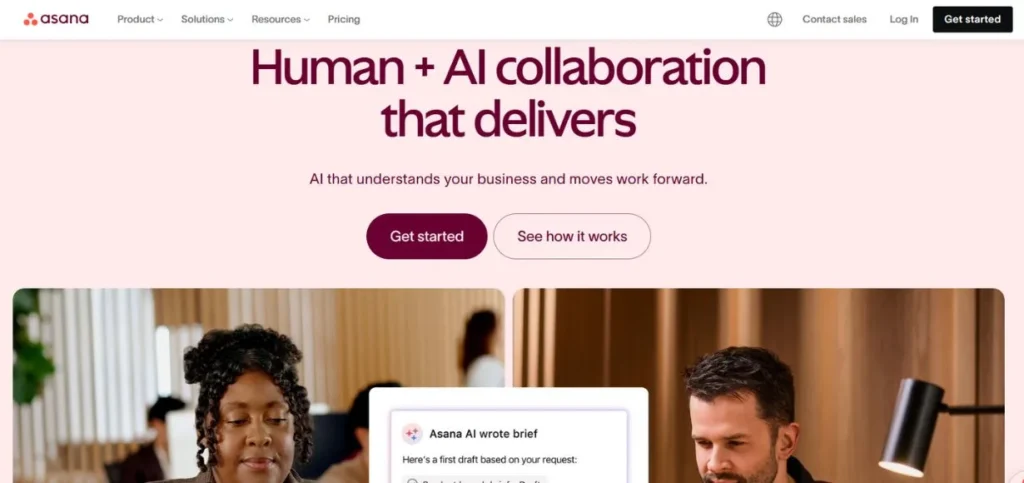
Asana is a cloud based productivity apps that in 2026 is the most structured and powerful project and task management application. Asana is trusted by Google, NASA and Airbnb teams as it helps organizations plan campaigns, manage workflows, and monitor goals to completion. It is simple to use, has a clean and intuitive interface, and teams can easily break big projects down into manageable tasks, assign owners, set deadlines, and visualize their progress using timelines, Kanban boards, and Gantt charts. The AI capabilities of Asana were launched as Asana Intelligence, and they assist organizations in anticipating risks, task assignments, and the decision-making process.
Key Features:
- Timeline and Gantt chart views
- Asana Intelligence AI automation
- Goal tracking and portfolio management
- Custom workflow rules and triggers
- 200+ app integrations
- Workload management for teams
Pricing: Free plan; Paid from $10.99/user/month (Premium)
Best For: Teams and managers running complex projects
Website: https://asana.com/
6. Trello
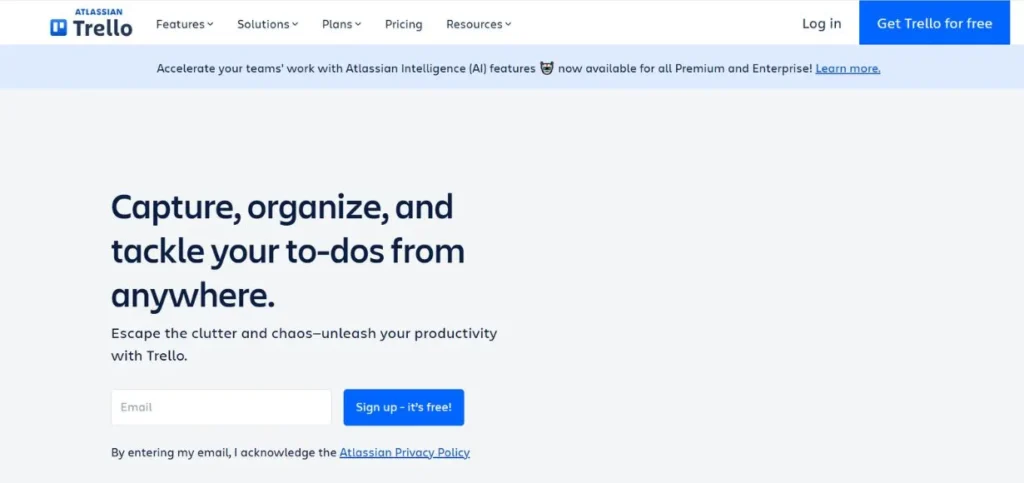
Ever since its debut, Trello has been known as one of the most accessible and visually enjoyable cloud based productivity apps to manage tasks with its iconic Kanban board interface, and it remains glittering in 2026. Trello is a non-technical, board-based, drag-and-drop tool owned by Atlassian, and it can be loved as simple (no steep learning curve). Trello has become much more than a simple Kanban with the inclusion of Butler AI automation, Power-Ups (integrations), and advanced views such as timelines and calendars, which allow teams to have flexibility and a visual understanding of the way their work works.
Key Features:
- Drag-and-drop Kanban boards
- Butler AI automation rules
- Power-Ups for third-party integrations
- Timeline, calendar, and table views
- Card checklists, attachments, and due dates
- Team and guest collaboration options
Pricing: Free plan; Paid from $5/user/month (Standard)
Best For: Individuals and small teams preferring visual task management
Website: https://trello.com/
7. ClickUp
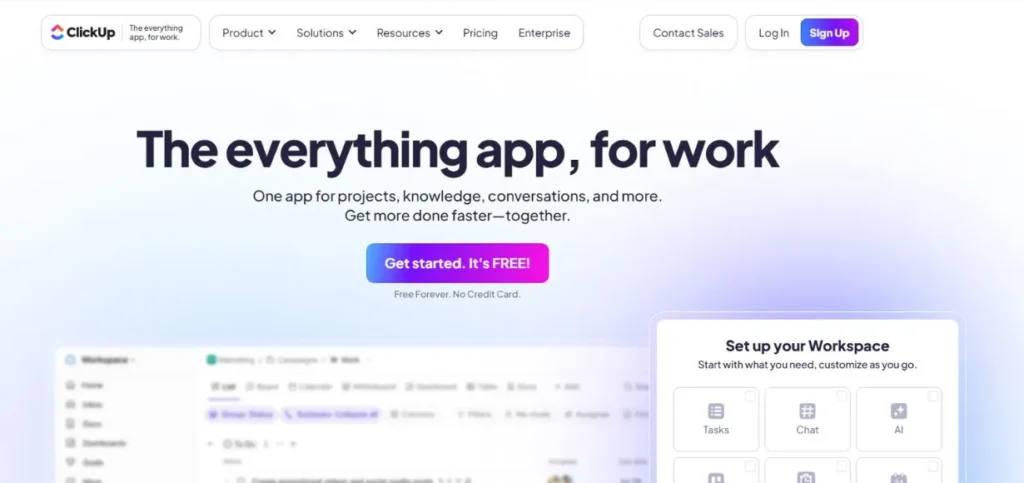
In 2026, ClickUp is probably the most flexible, packed with features of any cloud based productivity apps, which fulfills its ambitious claim of substituting other productivity solutions. Tasks, docs, whiteboards, goals, time tracking and built-in chat among others are all in a single place in ClickUp. The AI assistant, ClickUp Brain, has become one of its most notable features – assisting users in writing, summarizing tasks, creating action items, answering questions about their workspace, among other things. With more than 10 million users, ClickUp is most favored among tech teams, agencies, and rapidly growing startups.
Key Features:
- ClickUp Brain AI assistant
- Docs, Whiteboards, and Mind Maps
- Custom task statuses and workflows
- Built-in time tracking
- 1,000+ integrations available
- Goals and OKR tracking
Pricing: Free plan; Paid from $7/user/month (Unlimited)
Best For: Teams wanting an all-in-one project management hub
Website: https://clickup.com/
8. Notion
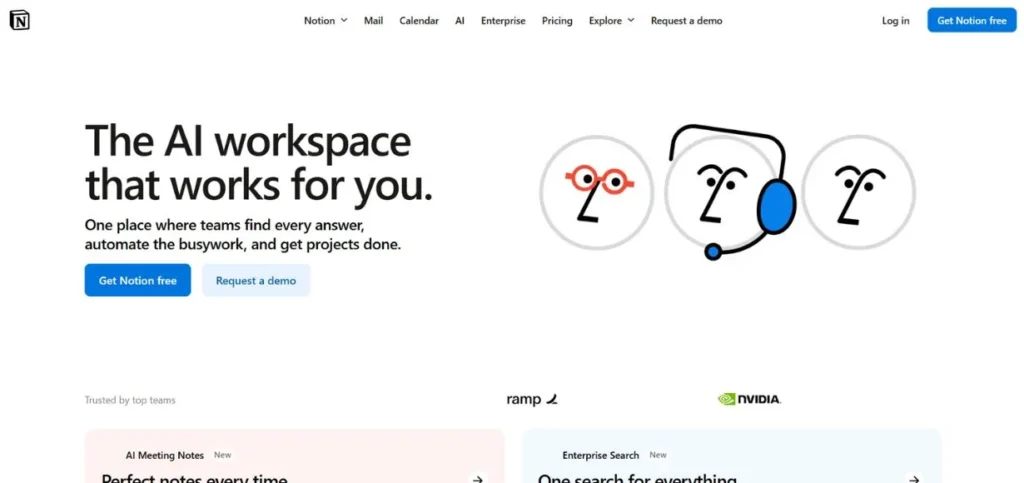
Notion has transformed into a note-taking application and has become one of the most popular and effective cloud based productivity apps in 2026. It is a combination of wiki, project manager and note-taking tool that comes in one beautiful miscellaneous workspace. The teams on Notion rely on it to build knowledge bases of the companies, run projects with their own databases and write documentation as well as to cooperate on the content everything in one place. Notion AI, which is built directly into pages, assists users to create content, auto-complete database properties, and translations notes and is popular with creative teams, product teams, and knowledge workers around the globe.
Key Features:
- Flexible pages and block-based editor
- Custom databases (table, gallery, calendar, list)
- Notion AI writing and summarization
- Team wikis and knowledge bases
- Real-time collaboration and comments
- Templates for every use case
Pricing: Free plan; Paid from $10/user/month (Plus)
Best For: Knowledge workers, creators, and product teams
Website: https://www.notion.so/
9. Google Sheets
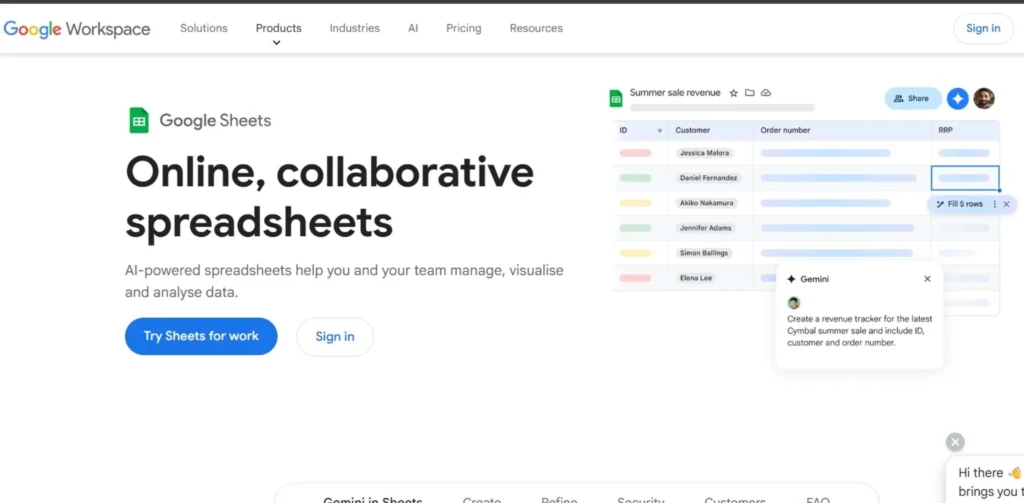
Google Sheets remains the most popular cloud spreadsheet app globally and one of the most convenient cloud based productivity apps for managing data in 2026. The only difference between it and other spreadsheet programs is that it supports real-time collaboration, allowing more than 2 people to edit the same spreadsheet with changes reflected in real time.
Google Sheets can be used to infinity and beyond, from budget tracking and data analysis to creating lightweight databases and automated reports. Its deep integration with Google Workspace, along with the new Gemini AI features for analyzing data and offering formula suggestions, has made it smarter and more powerful than ever.
Key Features:
- Real-time multi-user collaboration
- Gemini AI for formula suggestions
- 400+ built-in functions and formulas
- Native Google Forms and Data Studio integration
- Macros and Google Apps Script automation
- Free with any Google account
Pricing: Free with Google account; Google Workspace from $6/user/month
Best For: Data management, reporting, and team collaboration
Website: https://sheets.google.com/
10. Google Docs
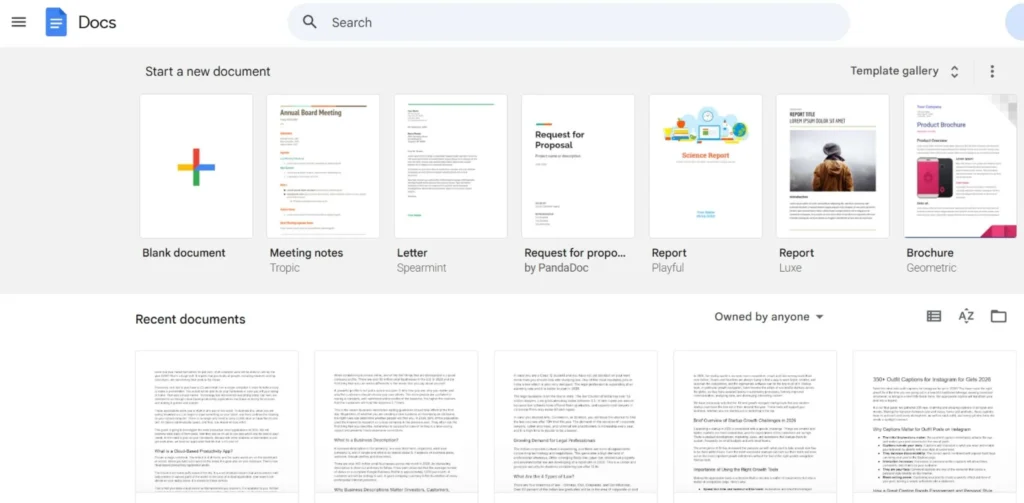
Google Docs is the document creation platform that assisted in normalizing cloud collaboration for millions of people across the world, and it will continue to be one of the most valuable cloud based productivity applications in 2026. Google Docs is a well-built and well-structured product; whether you are writing a business proposal, working on a report, or preparing a content brief, you will always have a clean and distraction-free interface with strong sharing and commenting functionalities.
The current integration of Gemini AI allows users to write complete documents by typing a prompt, summarizing long reads, and writing text in various tones, which greatly accelerates the workflow of writing for professionals, educators, and students.
Key Features:
- Real-time co-editing and comments
- Gemini AI drafting and summarization
- Version history and document recovery
- Voice typing support
- Offline editing mode
- Smart chips and @mentions
Pricing: Free with Google account; Google Workspace from $6/user/month
Best For: Document creation, writing, and team content collaboration
Website: https://docs.google.com/
How to Choose the Best Cloud Productivity App for Your Needs
- Find Your Core Use Case: Decide whether you require document editing, project management, team communication, or some combination and then consider tools.
- Think about Team Size and Scalability: Select a platform that can comfortably support your existing team with the potential to scale to the size needed as your business expands.
- Test Integration: Does the app tie in with your existing applications such as CRM, email or accounting software? Check that there are no workflow silos.
- Evaluate Prices and Values: Free and paid pricing plans are to be evaluated; other tools may provide excellent free versions and other tools may have essential functions as premium.
- Security and Compliance Checks: In the case of sensitive information, it is important to ensure that the platform is encrypted, has data residency services, and is able to adhere to regulations such as GDPR or HIPAA.
- Take the Test Before You Make a Truly Dedicated Purchase: Use a free trial to evaluate the level of ease of use, onboarding experience, and how much your team is actually liking using the tool on a daily basis.
Future Trends in Cloud Productivity Software
- AI-First Workspaces: All of the larger platforms will have an AI assistant that drafts, summarizes, automates, and predicts – human workflows will be tenfold faster in 2026 and beyond.
- Hyper-Personalization: Apps will develop autonomy in learning our user habits and tastes in order to provide a personalized feature, intelligent suggestions, and proactive suggestions to perform tasks.
- Single All-in-One Platforms: The dissimilarity of tens of applications will be substituted with single working areas (such as ClickUp and Notion) that will unite tasks, papers, and messages into one environment.
- More Rich Offline Features: Cloud products will be developed to offer full offline functionality, which will synchronize as soon as connectivity is regained, which is a must-have feature in remote and hybrid teams.
- Improved Security through Zero Trust Architecture: With the changing nature of cyber threats, a zero-trust architecture in cloud platforms will be applied, allowing access to be controlled through granularity and ongoing authentication.
- Sustainable Hosting: Accommodative data centers are becoming carbon-neutral and powered by renewable energy, and green cloud computing is a competitive advantage.
Conclusion
The cloud based productivity apps landscape in 2026 is more promising and competent than ever before. Whether you are a freelance entrepreneur attempting to be in control or a business team working on complicated multi-department projects, there is an ideal cloud tool to fulfill your requirements. Whether it is the giant all-in-one powerhouses like Google Workspace and Microsoft 365, or more specialized collaboration tools like Slack, Asana, or Notion, the choice is massive and smarter than ever.
The AI implementation across leading platforms has indeed elevated the definition of productivity to a whole new level, helping users write more quickly, make wiser decisions, and automate the trivial. It is not only about features, but also about choosing cloud-based productivity apps that match your workflow, culture, and growth objectives. We believe this guide has helped identify the most appropriate solutions for 2026. Sign up, explore what sounds like your team, and create a cloud-powered workflow that can help you do your best work every single day.
FAQs
What are cloud based productivity applications?
Cloud-based productivity applications are online software tools that assist individuals and groups in handling work, communication, and collaboration; they are available on any device connected to the internet.
Are productivity applications provided by the clouds secure?
Yes, trusted sites have enterprise-level encryption, multi-factor authentication and periodic security inspections to secure your information.
What is the most suitable cloud productivity application for small businesses?
Zoho Workplace and Google Workspace are both good for small businesses, offering great features at low prices and easy team onboarding.
Is it possible to use productivity applications based on cloud applications without charge?
Most of them, such as Trello, Asana, ClickUp, Notion, and Google Docs/Sheets, offer free plans with high limits that are intended for individuals and small teams.
What does cloud based app and traditional software mean?
Cloud-based productivity apps are hosted on remote servers, and traditional software is installed on local devices, offering real-time collaboration, auto-updates, and accessibility via any device.