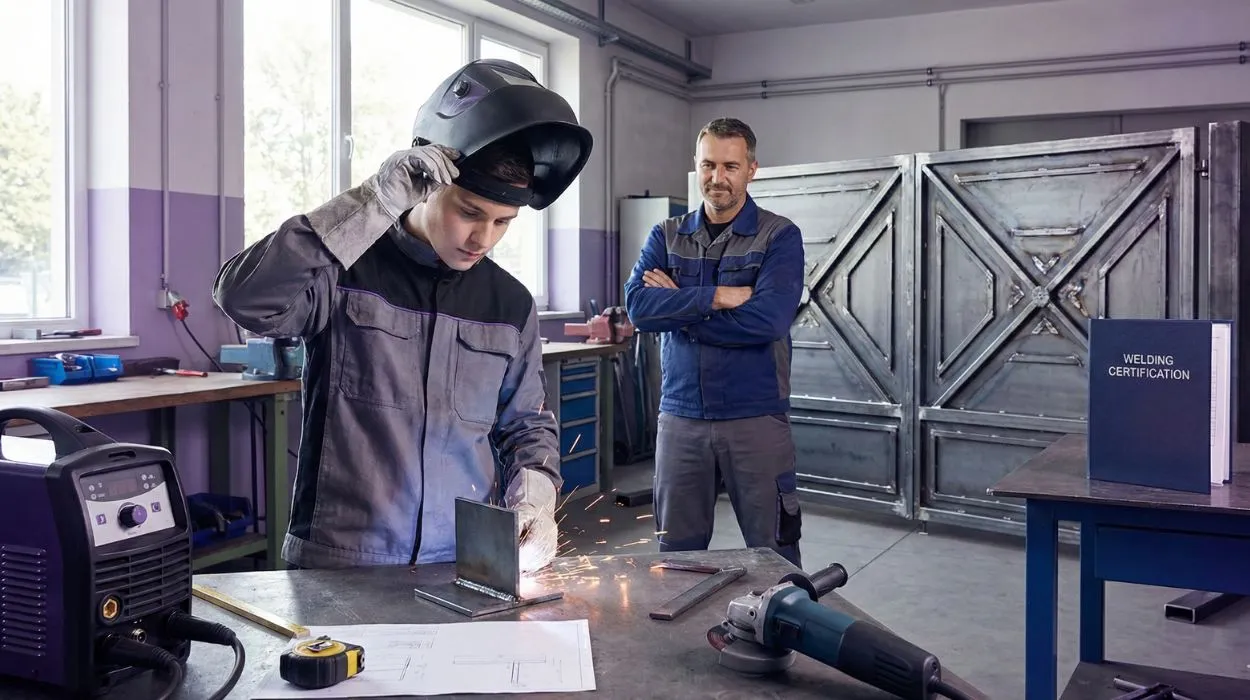
One of the most adaptable and marketable skilled trades in the present, welding provides both superior employment rates and a good income, and the reward of having made something with your own hands. You should look into becoming a welder if you are thinking of a technical but creative, problem-solving occupation. To learn how to be a welder, it is important to know what training opportunities, certification requirements, and career opportunities there are in this vital trade.
The job market for skilled welders remains strong due to the ageing infrastructure, the growth of manufacturing, and the opening of new construction projects around the country. This is a complete guide on how to become a welder in 2026, which will take you through the basics, such as training and familiarization with equipment, to the ultimate stage of professional certification. You will find the key steps, thrilling prospects, realistic pay details, and secrets that can assist you in your successful and rewarding welding career in the present competitive world of employers.
What Does a Welder Do?
- Assemble metal components: high-heat welders, including MIG, TIG, and stick welding, are used to form permanent connections.
- Read blueprints and technical drawings to be knowledgeable of the project specifications and measurements.
- Check welds: to ensure quality, strength, and to be in line with safety standards and industry regulations.
- Use equipment: Welding and cutting torches, grinders, welding machines, and other hand tools.
- Industrial work: construction and manufacturing, aerospace, motor vehicle, and shipbuilding.
- Be safe: through protective equipment, procedures, and clean working areas.
How to Become a Welder in 2026— Step‑by‑Step
In discussing how to become a welder, it is possible to follow these five basic steps, which will put you on the track to success:
1. Learn the Basics
Learning the basics of welding appreciates the basis of your whole career and helps you make sound training choices.
- Familiarize yourself with the research weldings such as MIG, TIG, stick, and flux core to determine which one you are interested in.
- Safety measures of the study include the correct use of PPEs, ventilation, and fire protection.
- Get tutorials from experienced welders and equipment manufacturers, and watch them on the internet.
- Master the jargon of welding to be able to communicate with the instructor and the employer.
- Learn metal characteristics and the reaction of various materials to heat and joining.
2. Get Training or Practice
Education or Apprenticeships offer a structured learning process that speeds up the acquisition of skills and offers you industry-recognized qualifications that employers find desirable.
- Take up vocational courses that provide 6-18 month courses on various methods of welding and certifications.
- Think of community college to get associate degrees with full training, as well as job placement.
- Apply to apprenticeships with paid work experience and classroom training within 3-4 years.
- Enroll in union programs that provide formal training opportunities and networks to good employers.
- Study in trade schools where they learn welding, including practical laboratories and instruction by professionals.
3. Gain Hands‑On Experience
On-the-job time welding provides muscle memory and confidence that changes the theory learned in the classroom to skills on the job, which are actively sought after by employers.
- Every day traininvolves spendingding hours in the welding booth, perfecting the technique in various materials and positions.
- Doing independent work, create a list of welds completed so as to show employers.
- Volunteer in local community projects, makerspaces, or theaters that require metal fabrication.
- Be employed as an assistant in watching master welders in the process of mastering the variables of the workplace and the industry methods.
- Play around with different challenges by working in vertical, overhead, and challenging positions to increase your versatility.
4. Certification Preparation
Professional certifications make your skills known to employers and greatly enhance earning power, and open up specialized jobs.
- Learn AWS requirements. Learn individual tests and standards of certifications you are seeking.
- Practice test jobs mastering of flat, horizontal, vertical, and overhead welds under time restrictions.
- Study codes and specifications of the welding learning industry that regulate professional welding work.
- Do practice tests that look like real certification tests to gain confidence and establish the weak areas.
- Get teacher advice.e Have skilled welders examine your work, and look over your work before you attempt formal certification.
5. Find Work & Grow Skills
To enter the job market, your career needs effective job hunting and adamant progression in the course of your employment.
- Prepare a portfolio of your finest welds and projects done to impress your prospective employers.
- Be active in networking through participation in trade shows, welding associations, and networking with industry players.
- Begin at any level by taking up the lowest ranks, where one stands a chance of learning, irrespective of low salaries to begin with.
- Become a specialist in the high-demand welding, such as underwater welding, pipe welding, or aerospace welding.
- Continuous learning with advanced certifications, new methods, and up-to-date with the technology trends.
How to Become a Welder With No Experience – Quick Guide
A large number of individuals question how to become a welder with no experience. The positive is that all should start somewhere, and the welding field is accessible to novices:
- Attend first classes: at the community colleges or at adult schools where they have low-cost introductory classes on welding.
- Get on apprenticeships: where skilled welders train you in the trade as you get paid.
- Begin as an assistant in welding shops to watch specialists, learn terminology, and know how to work.
- Makerspaces practice: or community workshops, where major investment is not required to gain access to equipment.
- Safety first: take the OSHA safety training to prove to employers that you are ready to work in a company.
- Be tenacious: due to the fact that a lot of employers do not care about previous experience as much as they do about attitude and readiness to learn.
How to Become a Welder Without Going to School – Quick Guide
It can be learned how to become a welder without attending school through the following avenues:
- Complete a training program through an apprenticeship: by using unions, trade associations, orthe company. Some companies have organized apprenticeship programs.
- Get employed as a helper, and be trained on the job by skilled welders who are ready to take on new workers.
- Practice alone: through the acquisition of simple welding tools and self-learning at home.
- Access internet materials: such as YouTube tutorials, forums on welding, and free washer-manufacturers’ educational information.
- Offer your expertise: in community work, theater, or art installation where metal fabrication is required.
- Build a network: consider the opportunities and ask working welders about the opportunities and advice by attending industry events.
How to Become a Welder as a Woman – Quick Guide
Women who think that they would like to become a welder will realise that the world becomes more welcoming and accepting of them:
- Get connected to organisations, such as Women Who Weld or other organisations offering mentorship and support networks.
- Identify supportive employers who embrace diversity and have inclusive and respectful cultures at the workplace.
- Get quality equipment, such as high-quality PPE that fits other body types safely and comfortably.
- Develop confidence: the ability to build it through building their skill rather than allowing stereotypes to cause doubts in them.
- Find female mentors who have succeeded in the industry and may provide advice on certain issues.
- Self Advocate: through building professional boundaries and communicating needs on the first day.
How to Become a Certified Welder 2026 – Table
| Certification | Issuing Body | Value |
| Certified Welder (CW) | American Welding Society (AWS) | Industry-recognized standard proving fundamental welding competency |
| Certified Welding Inspector (CWI) | American Welding Society (AWS) | Advanced credentials for quality control and inspection roles |
| Certified Resistance Welding Technician | American Welding Society (AWS) | Specialized certification for resistance welding processes |
| ASME Section IX | American Society of Mechanical Engineers | Required for pressure vessel and boiler welding work |
| Structural Welding Certification | AWS D1.1 | Essential for construction and structural steel welding |
| Pipe Welding Certification | Various standards (API 1104, AWS D10.11) | Critical for oil, gas, and pipeline industry employment |
How Long Does It Take to Learn to Be a Welder?
- Entry level: can be achieved in 6-8 months by rigorous vocational training, jogging.
- Vocational programs: these programs last 6-18 months, and the processes covered.
- Associate degrees in welding technology require approximately 2 years of fully developed education and certifications.
- Duration of apprenticeships: 3-4 years of combined classroom training and paid working hours in thousands of hours.
- The art is acquired over years of constant training on various materials, poses, and special purposes.
- Timescale: depending on the rate of learning, frequency of practice, innate abilities, and the ambitions of the career being followed.
How Much Do Welders Make? Salary Insights

Possibly one of the most frequently asked questions in learning how to become a welder is in regard to earning potential. The following is what welders normally produce:
| Experience Level | Annual Salary Range | Hourly Rate |
| Entry-Level Welder | $30,000 – $40,000 | $14 – $19 |
| Mid-Level Welder (3-5 years) | $40,000 – $55,000 | $19 – $26 |
| Experienced Welder (5-10 years) | $55,000 – $70,000 | $26 – $34 |
| Specialized Welder (Pipe, Underwater) | $70,000 – $100,000+ | $34 – $48+ |
| Welding Inspector/Supervisor | $60,000 – $85,000 | $29 – $41 |
| Traveling/Industrial Welder | $75,000 – $150,000+ | $36 – $72+ |
Is 25 Too Old to Start Welding?
No—25 years is in fact a great age to train to be a welder, and some would say it iseven better than immediately after high school. Most talented welders begin training in their mid to late twenties or even later after trying other professions, life experience, or finding that they want to work a more hands-on job. You are 25, and you come with maturity and da eveloped work ethic, and good life experience that the younger students may still not have yet. Age is of less value than skill, dedication, and reliability in the welding industry, and you will still have 40 years or more of a productive career ahead of you.
Age is not as important as physical fitness and hand-eye coordination in this hands-on trade, and most 25-year-olds are actually in their physical prime to be taught physically challenging skills. Most employers and training systems, in fact, favor slightly older apprentices who are more reliable, committed to completing what they begin, and professional enough. At 18, 25, 35, or even 45, should you be willing to learn, work hard, and devote yourself to excellence, welding is a legitimate and challenging career choice that has great long-term opportunities.
Welding Career Paths & Growth Opportunities
- Niche welding: in the high-need niche, such as underwater welding, aerospace welding, nuclear welding, or robotized welding.
- Welding inspection: certification of welds, quality control, and code compliance.
- Welding training: instruction at a vocational school, community college, or conducting a private training workshop.
- Fabrication management: steward management of teams, project management, and manufacturing management.
- Engineering technician: This is a role in which engineers and technicians come up with product development, testing, and prototype development.
- Business ownership: start your own welding store, mobile repair shop, or custom fabrication shop.
Pros & Cons of a Welding Career
Pros
- High demand: as the jobs are available in various industries and in different areas.
- High-salary: high-paying, work overtime, and can earn six figures with specialized pay.
- Practical experience: delivering physical conclusions and fulfillment through generating visible and sustainable structures.
- Fast track: it only takes a shorter time and financial resources to put a career in place than four-year degrees.
- Diversity of the work: different industries, projects, and specializations do not allow monotonous work.
- Prospects of growth: providing opportunities forsupervision, inspection, teaching, or owning a business.
Cons
- Physical strains: it involves working long hours, working in awkward positionsandas working with heavy materials.
- Hazards to safety: high heat, toxic fumes, bright light, and burns or injury possibilities.
- Severe conditions: when the conditions are extreme, the work is done outdoors, in narrow spaces, and in difficult conditions.
- Eye strain: due to excessive exposure to light, the need to wear adequate protection, and the long-term eye risks.
- Irrational hours: in certain industries, where there are layoffs during low economic periods or during project closures.
- Health hazards: through long-term fume exposures, repetitive movements, and physically involved type of work.
Conclusion
Knowledge on how to become a welder is a way to get access to a truly satisfying profession that is half craftsmanship, half modern technical, and half creative problem-solving. Be it formal training at a vocational college, a formal apprenticeship program, or a self-driven learning process, the path to becoming a welder is easy and attainable to people with motivation and willingness to make the effort.
Welding careers have very high income potential with six-figure earnings in niche sectors, high job security during recessions and booms, and a wide range of employment in construction and manufacturing, aerospace, and shipbuilding. It is important to remember that becoming a welder is not only a matter of learning to do MIG, TIG, or stick welding but a matter of becoming a skilled trade that literally keeps our infrastructure, our vehicles, our buildings, and our bridges in place.
When you are willing to get down to work that can make a tangible difference in the world, and then you can get a career where the fruits of your labor will be visible, then welding may be your ideal career match in years to come.
You might also like:
FAQs
Will I be able to teach myself how to weld without the training?
Yes, you can learn by practice and online resources, but formal training is strongly suggested. Professional programs will learn proper techniques, safety in the industry, and prevent bad habits. The employers tend to hire certified welders due to insurance and safety considerations.
What is the best welding process to learn?
MIG (Metal Inert Gas) welding tends to be the most suitable one in the case of a novice. It is more manageable, it makes cleaner welds, and it makes you more confident before transitioning to higher-end processes such as TIG or Stick welding.
Do I require excellent vision to be a welder?
You do not need flawless vision, but you need to be able to have your eyesight corrected with glasses or contacts so that you can be precise and safe.
Could one have a family and still be a good welder?
Yes, there are numerous welding opportunities with stable income, regular working hours, and benefit packages that provide a balance between work and family life.