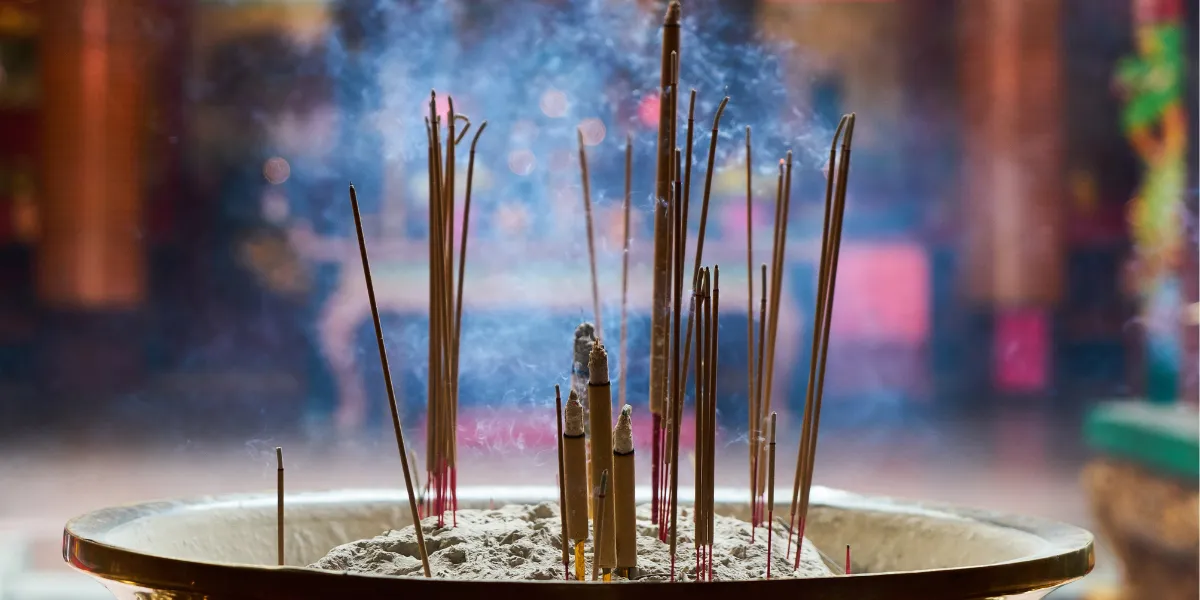
huge market, and the country is one of the top producers and consumers of incense sticks. Daily production of agarbatti in India is about 1,400 tons, out of which a large part goes to different countries as exports. This industry is the source of income for millions of people, mostly women from rural areas, thus it has a positive social impact. Karnataka, Maharashtra, Gujarat, and Tamil Nadu are the main states where most production takes place.
If you’re exploring how to start agarbatti business, this strong demand and widespread production make it a highly promising small-scale venture. Agarbatti is still very much in demand due to its use in religious events, meditation, therapy, and daily rituals in Hindu, Buddhist, and Jain households.
Why Agarbatti Business is Considered Profitable and Low-Investment
- Minimal initial capital requirement – It is possible to launch the business with an amount that ranges from ₹10,000 to ₹50,000.
- Evergreen demand – The consumption that takes place on a daily basis makes it possible for the sales to be consistent all year round.
- High-profit margins – Depending on the quality and the brand, the profit margin usually lies within 30-50%.
- Simple production process – It is not difficult to learn and requires little technical knowledge.
- Low operational costs – The cost of raw materials is low and they are easy to find.
- Scalable business model – Start small in your home and grow by expanding as you develop.
- Government support – There are a number of schemes and subsidies for the MSME sector that help entrepreneurs in the government.
- Export potential – The increasing international demand will give rise to another source of income for the company.
Why Start an Agarbatti Business
- Cultural Relevance – The practice of burning incense has been a part of Indian culture and religious practices ever since, and it will keep the market demand steady across generations.
- Work From Home Opportunity – The business can be conveniently started from your home with minimal space requirements, making it a perfect opportunity for homemakers and first-time entrepreneurs.
- Flexible Investment Options – There is an appropriate entry point for every budget level, whether you have ₹10,000 or ₹10 lakhs.
- Women Empowerment – The agarbatti industry has been a source of employment mainly for women workers; hence, it becomes a good business for female entrepreneurs and opens up employment opportunities for other women as well.
- Steady Cash Flow – Unlike seasonal businesses, agarbatti has constant demand throughout the year, thus, revenue generation is consistent and inventory turnover is quick.
- Multiple Revenue Streams – Retailers, wholesalers, temples, hotels, yoga centers, online platforms, and even export markets are some of the channels through which you can sell simultaneously.
Types of Agarbatti Business
- Manufacturing Business – Get the raw materials and machinery to make agarbatti from the scratch
- Trading/Distribution Business – Obtain the finished products from the manufacturers and sell them to retailers
- Franchise Business – Establish partnership with the recognized companies and run their brand with their help
- Export Business – Sell to overseas markets keeping the quality products in the premium category
- Custom/Boutique Agarbatti – Offer hybrid products of incense sticks like rare, handmade and organic for selective markets
- Raw Material Supply – Delivering bamboo, scents, and other inputs to the manufacturers
- Home-Based Rolling – Hand-rolled agarbatti as a small home-run business
- Automated Manufacturing – High-output production using totally automatic machines.
Step-by-Step Guide on How to Start Agarbatti Business (2026 Guide)
Step 1: Market Research & Target Audience

To start with, get to know your market forces and find your perfect customers. Go to the local temples, retail stores, and wholesalers to examine the pricing, choice of fragrances, and packaging materials. Study your competition to know what is selling and what is not in the market that you can exploit.
Decide on whether you will serve the low-marketing segment, high-end buyers or targeted segments such as organic fans or export markets. The secret of knowing how to enter an agarbatti business is to know your listeners or viewers well.
- Understand the market & demand
- Identify ideal customer segments
- Analyze pricing and product variety in local stores
Step 2: Agarbatti Type Definitive (masala, dhoop, Herbal)

Select your product line in accordance with demands of the market and your production potential. Masala agarbatti is made with natural ingredients that are blended into a paste and that provide rich and traditional scents such as sandalwood, jasmine and rose. Dhoop sticks are less bamboo-filled and fat incense that can be used during religious rituals and meditation.
Herbal/organic agarbatti is progressing in the health-conscious customers with demand for non-chemical agarbatti. You can also make scented agarbatti using synthetic perfumes to mass market or custom make high end lines using natural essential oils.
Options include:
| Type | Features | Target Customers |
|---|---|---|
| Masala Agarbatti | Natural powdered paste, rich aroma | Traditional users |
| Dhoop Sticks | Without bamboo, strong fragrance | Ritual/meditation |
| Herbal/Organic | No chemicals, eco-friendly | Health-conscious |
| Synthetic/Perfumed | Mass production | Budget customers |
Step 3: Sourcing Raw Materials: Bamboo Sticks, Charcoal, Fragrance Oils, Powders.

Get supply of raw materials of good sources to secure the same source of quality products. The materials necessary are bamboo sticks (comes in a variety of lengths), charcoal powder (binding agent), jigat powder (adhesive manufactured out of wood bark), sawdust or wood powder (base material) and fragrance compounds or essential oils.
You will also require premix powder to coat and package such materials as boxes, plastic bags, and labels. Build contacts with various suppliers to prevent any hiccups in the production process and will be able to negotiate a reduced price in bulk with some of them as your production scale increases.
Essential Materials
- Bamboo sticks (8″–12″)
- Charcoal powder
- Jigat powder (adhesive)
- Wood powder
- Fragrance oils / essential oils
- Ready-made premix (optional)
- Packaging materials:
- Printed boxes
- Poly pouches
- Labels
Step 4: Select a Manufacturing Process: Manual Rolling, Semi-Automatic, Fully Automatic.

Choose how to produce depending on your ambitions of budget and scale. Manual rolling is very cheap ( ₹10,000-25,000) and suited to beginners with the lowest production scale of 3-5kg/day. Semi-automatic machines are priced at ₹50,000-2 lakhs and can weigh more than 20-40 kg every single day and still have fewer employees.
Fully automatic machines are also needed with investment of 3-10 lakhs and produce 50- 200 kg/day with high consistency. Knowing how to get an agarbatti business requires the decision on the desired technology.
Select based on your budget & production goals:
| Process Type | Investment | Production Capacity |
|---|---|---|
| Manual Rolling | ₹10,000–₹25,000 | 3–5 kg/day |
| Semi-Automatic Machine | ₹50,000–₹2 lakh | 20–40 kg/day |
| Fully Automatic Machine | ₹3–₹10 lakh | 50–200 kg/day |
Step 5: Considerations of Packaging and Branding.

Design eye-catching and informative packaging that is unique and distinct in the retail shelves and delivers your brand values. You need to create a recognizable brand name and a logo that comes out as quality and traditional. Put necessary data such as type of fragrance, quantity and date of manufacture on packaging.
Look at greener packaging to attract greener consumers. Spend money on quality boxes and pouches printing in order to buy a professional image. The packaging should be the initial contact with our customers, and it should not be wasted.
What to include:
- Brand name & logo
- Fragrance name
- Stick count / weight
- MRP + Manufacturing date
- Usage appeal (e.g., meditation, puja)
Brand value add-ons:
- Eco-friendly packaging
- Attractive color themes
- QR code for online buying
Step 6: licensing and registration requirements (GST, MSME Registration)

Get your business legally registered to run without hustles and enjoy the benefits of the government. Register GST in case your turnover is higher than ₹40 lakhs (20 lakh states which are in the special category).
Register free of charge and apply online to access loans, subsidies, and government schemes to the MSME/Udyam. Take out a trade license with the local municipality. In case of manufacturing in house, be sure that it complies with local zoning accords. Look at trademark registration to make sure that your brand name and logo is not copied.
Required registrations:
- GST Registration: (not mandatory until ₹40 lakh turnover / ₹20 lakh for special states)
- MSME/Udyam Registration (Free online)
- Local Municipal Trade License
- Trademark Registration for brand protection (optional but recommended)
Step 7: Distribution and Sales Channels (Local Retailers, Online Marketplaces, Export).

Exploit multi-channel distribution model in order to reach maximum number of people in the market and increase revenues. Begin by delivering the local kiryana shops, puja shops and supermarkets in your locality. Acquire wholesalers and distribution networks to cover greater areas.
Register on online stores such as Amazon, Flipkart, Meesho and IndiaMart to reach online customers. Go to approach temples, ashrams, hotels and yoga centers to make bulk orders. You can also venture to export markets when you grow by registering with APEDA and international trade portals with the USA, Europe and the Middle East countries as the target markets.
Local Sales:
- Kirana stores
- Puja & gift shops
- Supermarkets
- Temples & ashrams
Online Platforms:
- Amazon, Flipkart, Meesho, IndiaMart
Bulk Purchase Clients:
- Hotels, yoga centers, cultural events
Export Markets:
- Middle East, USA, Europe
Read More: How to Start a Plastic Recycling Business
Agarbatti Manufacturing Cost & Profit
Knowledge on financial details of agarbatti business start up is essential to success. Agarbatti is cheaply produced with a cost per kilogram in between 120 and 180 depending on the quality of raw materials and fragrances. Here, there are expenditures on bamboo sticks, premix powder, charcoal, fragrance, packaging and labor.
The finished product can be sold at 0.180-300 per kg to retailers, or 0.250-500 per kg directly to the consumers based on the quality and branding. This is equivalent to 30-50% profit margin. A small business making 5-10 kg per day is able to make a monthly profit of ₹15,000 to ₹45,000. Automated units of 50-100kg per day can give monthly profits over 1.5-3 lakhs.
Funding & Government Support
- MSME Loans- Banks and NBFCs provide collateral free loans to the extent of ₹10 lakhs to the registered micro and small businesses under the MSME category at a conducive interest.
- Pradhan Mantri MUDRA Yojana- Access loans until ₹10 lakh without collateral in Shishu (up to ₹50000), Kishore (₹50000-5 lakh), and Tarun (₹5-10 lakh) categories targeted exclusively to small businesses.
- Prime Minister Employment Generation Programme (PMEGP) –Under this government programme, the subsidy on the cost of the project of establishing new agarbatti manufacturing units is 15-35%.
- Stand Up India Scheme – Unloaned Women and SC/ST Women on the one hand can avail loans amounting 10-1 crore to start manufacturing businesses.
- Coir Board Subsidies- Use of natural fibers and more friendly production materials can have extra subsidies provided by the Coir Board on sustainable production practices.
- State Government Schemes- Consult your state MSME department on the extra incentives, subsidies and support programs in your particular region industrial policy.
How to Sell & Market Agarbatti
- Direct retail strategy- Directly visit and distribute to the local shops, temples and supermarkets.
- Distributor network- Use Appoint distributors in various regions as a distributor with greater geographical coverage.
- Online presence – Establish business profiles on internet heralders and social media.
- Free samples policy- Issue free samples to target customers and retailers and establish trust.
- Festivals targeting- Production and marketing- More production and marketing of the product during Diwali and Navratri festivals and other religious festivals.
- Bulk purchases – Target hotels, spa, in-centre meditation, and corporate offices on a frequent bulk purchase basis.
- Appealing packages –Offer combo packages, season deals, and loyalty cards to sustain the customers.
- Consistency of quality- Adhere to the quality of products to create word of mouth referrals and the ability to do business again and again.
- Brand building- The company should invest in packaging, social media advertising and in local advertisement to create awareness of the brand.
- Export orientation- Register with APEDA and attend trade fairs in order to find out world markets.
Conclusion
Acquiring knowledge about the way to start agarbatti business is like getting one step closer to the gigantic world of entrepreneurial ideas that are all based on the rich cultural heritage of India. The agarbatti making industry has a great combination of earning good money, being able to positively affect the society, and personal happiness. If you are a housewife wanting to earn a little extra money, a young wolf of the stock market who is looking for the first venture, or an established businessman who is looking to add another one to your portfolio, the agarbatti business is there for you with open hands and very few restrictions.
The learning process of how to start an agarbatti business to the point of being a successful manufacturer takes a lot of effort and putting emphasis on the quality of the product along with a good marketing strategy. It has been recommended that you should begin small, keep the quality very high, have strong connections with the suppliers and customers, and then grow slowly. Considering the increasing worldwide demand for aromatherapy, meditation, and Indian spiritual practices, your agarbatti business could be successful both locally and globally. Be brave and take that first step today to make the fragrant reality out of your entrepreneurial dreams!
FAQs
What amount of money is necessary for starting an agarbatti business?
Depending on your scale you can commence with a manual rolling which costs ₹10,000-25,000 or a semi-automatic machine which costs ₹50,000-2 lakhs.
Is it obligatory to have GST registration for agarbatti business?
GST registration is implemented only when your total revenue for the year goes above ₹40 lakhs (or ₹20 lakhs in certain states).
Am I allowed to operate an agarbatti business from home?
Indeed, the agarbatti industry is perfect for household commerce initially, and it requires very little space, about 200-300 square feet for the production of small scale.
What is the profit margin percentage in the agarbatti industry?
The profit margin is usually between 30-50% and it varies according to production cost, quality, branding, and your selling points.
How can I get the customers for my agarbatti items?
A good starting point would be local retailers, temples, and wholesalers followed by online marketplaces such as Amazon and IndiaMart, and finally, the consideration of export markets.