Speed is all that is demanded in the current fast-paced digital world. Companies should not be able to wait months-and probably years- to have a web application developed. On that note, Rapid Web App Development Tools come in. These are powerful platforms that enable developers, startups, and even non-technical teams to build, test, and launch fully operational web apps in a fraction of the time it would otherwise take.
No matter whether you are a solo founder who has to create an MVP or have to upgrade legacy systems, the right Rapid Web App Development Tools can reshape your working process, save money and allow you to be the first to launch in the market.
What Is Rapid Web App Development (RWAD)?
Rapid Application Development (RAD) is a faster, feedback-driven approach to software development that values rapid prototyping and continuous improvement, consults with end-users during design to satisfy their dynamic requirements, and values collaboration between software developers, designers, and customers.
RWAD, in basic terms, refers to the process of creating web applications much faster through a lack of an extensive planning process, visual drag-and-drop interfaces, reusable elements, and artificial intelligence support; all of which are in combination with constant user feedback in each cycle.
Why Rapid Development Tools Are Trending in 2026
- AI-Powered Everything: Rapid Web Application Developers: These tools now include built-in AI assistants that have the ability to create complete applications by typing a few words and reduce the time required to develop an application by many hundredfold.
- Booming Market Size: The Rapid Application Development market in the whole world was worth USD 56.5 billion in the year 2025, and it is expected to rise to USD 79.2 billion in the year 2026 with a CAGR of 40.2.
- Citizen Developer Revolution: This is where the non-technical employees can now create their own business tools without going into code writing.
- Reduced Time-to-Market: The 2024 Reveal survey revealed that 90.4 percent of development teams claimed higher productivity with low-code solutions, and that also 43.5 percent of the survey respondents had reduced their development time by up to half.
- Low-Code Dominance: The low-code/no-code market was expected to reach close to 30 billion of dollars in 2025, with a comparison of 70 percent of all new applications that are run on low-Code or no-Code technologies.
- Cloud-based Development: It is a modern rapid web application development that utilizes cloud-based technologies to provide teams the ability to work anywhere in the world in real-time.
Also Read: PDF Drive Alternatives
Best Rapid Web App Development Tools 2026 (Comparison Table)
| Tool | Best For | Free Plan | AI Support | Mobile Support | Open Source |
| Retool | Internal Tools | (5 users) | Yes | Yes | No |
| Bubble | No-Code Web Apps | Yes | Yes | (Responsive) | No |
| OutSystems | Enterprise Apps | No | Yes | Yes | No |
| Mendix | Enterprise Low-Code | Yes | Yes | Yes | No |
| Lovable | AI-Powered MVPs | Yes | Yes | Yes | No |
| Budibase | Open-Source Internal Tools | Yes | Yes | Yes | Yes |
| Microsoft Power Apps | Microsoft Ecosystem | No | Yes | Yes | No |
| Appian | Process Automation | No | Yes | Yes | No |
| Zoho Creator | SMBs & Startups | Yes | Yes | Yes | No |
| WaveMaker | Enterprise Web Apps | No | Yes | Yes | (Community) |
Top 10 Rapid Web App Development Tools (2026 Detailed List)
1. Retool
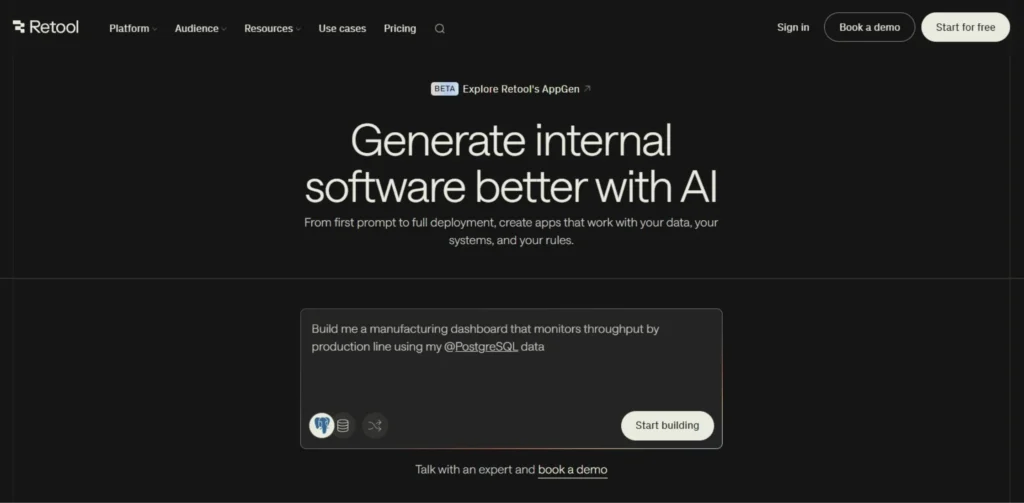
Retool is equally one of the best-popular Rapid Web App Development Tools to assemble potent internal business applications. It is a low-code development system to create internal business apps, business tooling, without code writing, whether it is to create an admin dashboard with CRUD support, MVPs, reporting dashboard, or an approval workflow. Retool is directly integrated with databases and APIs via a drag-and-drop interface, which is popular with engineers who write in SQL and JavaScript.
Key Features
- Drag-and-drop UI builder
- 80+ pre-built integrations
- React components support Custom react components.
- Git sync & self-hosting
Pros
- Unbelievably rapid tool building internally.
- Rich API connectivity and database.
- Per-builder pricing which is cost effective.
Cons
- Unsuitable with customer-facing applications.
- Performance problems of high complexity.
- Per-user price scales cost prohibitively.
Best For: Internal dashboards & admin panels
Pricing: Small teams are free; a business plan is available for $50/user/month, with an outcome of a 20% discount when billed annually.
Website: retool.com
2. Bubble
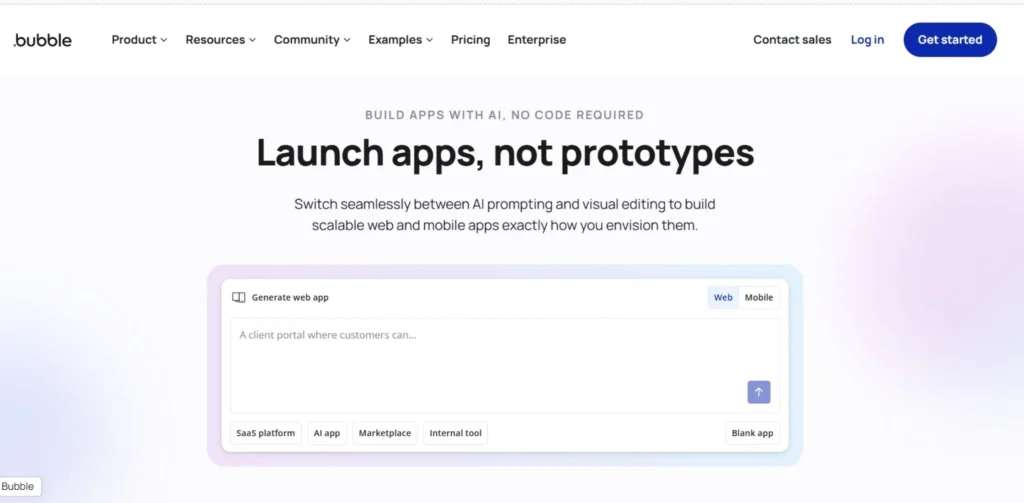
One of the most powerful Rapid Web App Development Tools that builds complex, customer-facing web applications is Overview Bubble, which is a no-code dominant tool. Using this no-code tool, you can create marketplace applications, sales applications, productivity applications, and social network applications, or even an innovative AI-based application. The workflow builder of Bubble, involves multi-step processes that do not require a single line of code to use, making it the best solution both to an entrepreneur and a product manager.
Key Features
- Drag and drop programming: Visual.
- In-built database management.
- Stripe Connect for payments
- Extension market place.
Pros
- No coding knowledge needed
- Very flexible and adaptable.
- Big social network and support.
Cons
- Complicated applications have steep learning curves.
- Workload Unit pricing can be rather a surprise to its users.
- Web-based, no local mobile applications.
Best For: No-code web app founders.
Pricing: Free plan available. Plans start at 29/month, Growth at 119/month, Team at 349/month.
Website: bubble.io
3. OutSystems
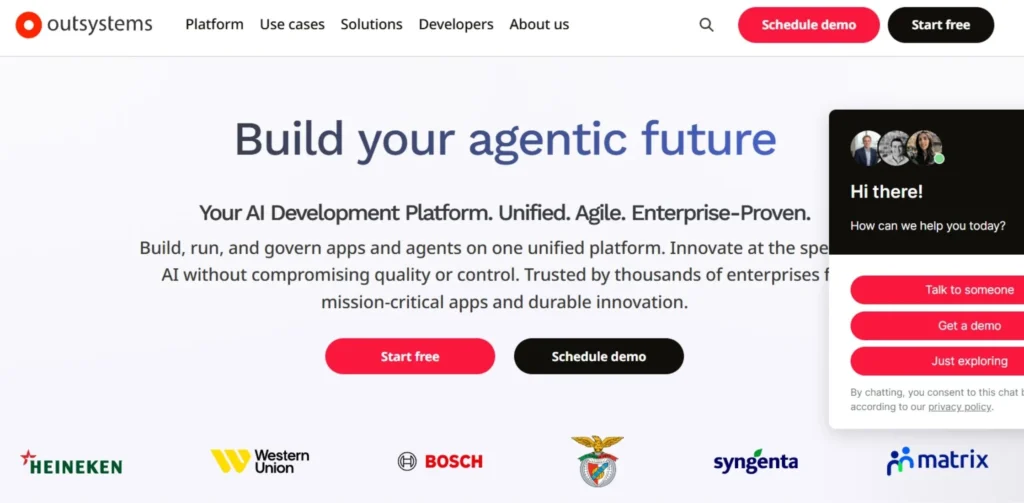
OutSystems is a business-tier system with arguably the strongest Rapid Web App Development agency to be used by large companies. OutSystems offers a high-speed, adaptable, low-code development platform that facilitates the quick and agile development of intricate applications, simplifying the creation of the needed application without compromising quality. OutSystems has continued to make strides since 2026 into becoming an AI-enabled low-code platform with its GenAI toolset, Agent Workbench to coordinate AI agents, and AI-mediated code checks, making it one of the most technically advanced RAD platforms on the market.
Key Features
- End-to-end application lifecycle management.
- Code review based on AI (Agent Workbench).
- Smooth integration of API and legacy systems.
- FedRAMP and compliance at the enterprise.
Pros
- Whereas the others have their limits, this product operates on an unmatched enterprise scale.
- Powerful security and compliance applications.
- Gartner Leader 9 years in row.
Cons
- The price of entry is very high.
- Risk of serious vendor lock-in.
- Migration takes a complete rebuild of the app.
Best For: Large enterprises & mission-critical apps
Pricing: Developer Cloud begins at $36,300/year, comprising dev, test and production environments with 100 internal users.
Website: outsystems.com
4. Mendix
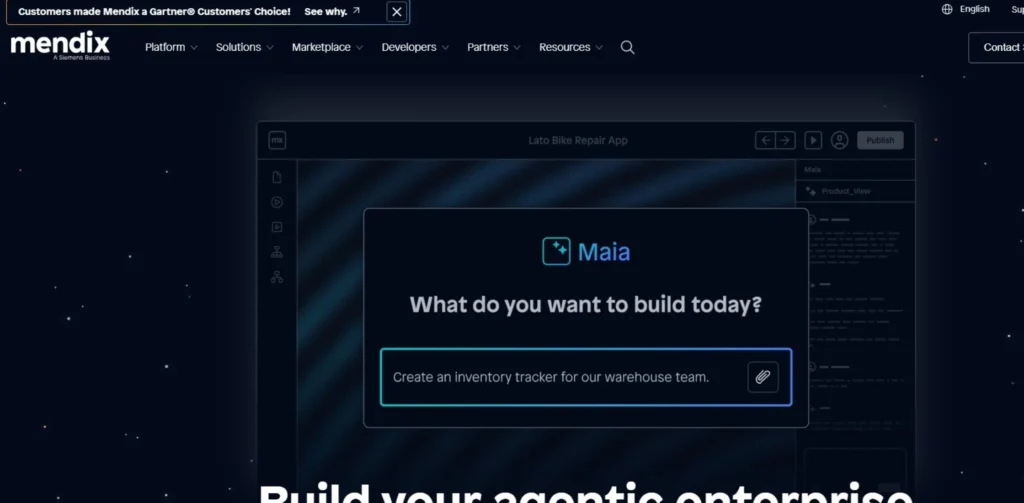
Mendix is an end-to-end Rapid Web App Development Tools platform that is developed to serve a company that is interested in bridging between the technical and non-technical teams. Mendix has collaboration tools, autotesting and integration with third companies. It also provides a platform of ready-made application segments and templates to hasten the development process right at the start. Being a Siemens company, Mendix remains a Gartner Magic Quadrant Leader in 2026.
Key Features
- Model-based graphic development.
- In-built Git & agile project management.
- Components marketplace of pre-built components.
- Completion in the cloud and on the premises.
Pros
- Growing citizens and professional developers.
- Powerful ready built templates.
- Great profile of compliance to the enterprise (SOC 2, ISO 27001).
Cons
- Difficult entry barrier among novices.
- Scalable expensive (Standard at $998/month per app)
- Large volumes of data are problematic to performance.
Best For: Enterprise teams & collaborative agile development
Pricing: Free plan available. In the case of one application: Basic, which costs 75 a month and Standard, which costs 998 a month. Unlimited apps: Standard at $2,495/month.
Website: mendix.com
5. Lovable
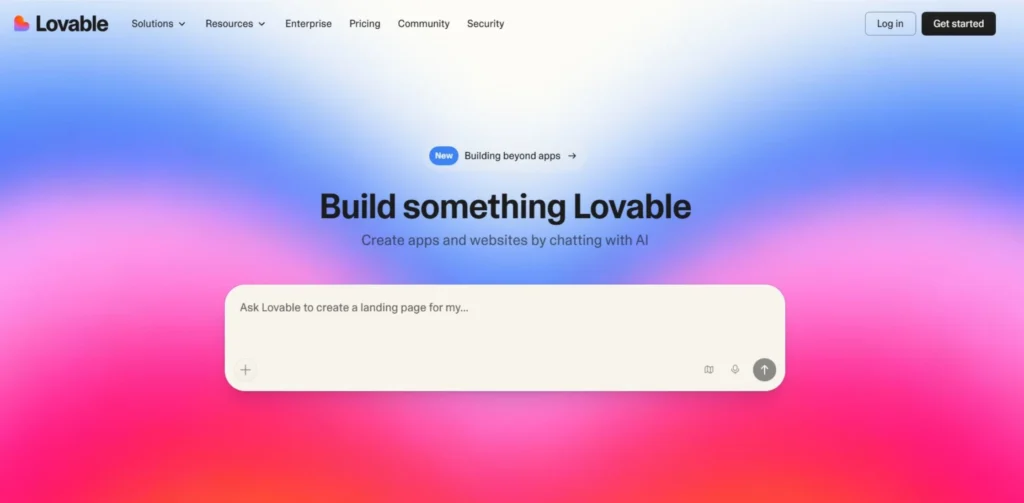
Lovable Lovable is an AI-centric platform and one of the most remarkable emerging Rapid Web App Development Tools in 2026. Lovable is an AI app builder, which means that and writes prompts into working web applications. In other words, you explain what you need to build, and Lovable creates a complete, full-stack web application. It is well suited when founders or product managers need to deliver an MVP or prototype within minutes without the help of a full engineering team and when they communicate to create apps with a conversational Agent Mode in hours.
Key Features
- Natural language prompt to application generation.
- Generation visual drag and drop editor.
- Native Support Sybase and Stripe integration.
- GitHub bi-directional ownership of code.
Pros
- Build apps with zero coding
- Full code ownership & export
- Price sharing (not user-based)
Cons
- The old GitHub repos can not be imported.
- Supabase required to support backend features.
- there are no existing projects to import into — just new apps.
Best For: Founders, MVPs & rapid prototypes
Pricing: Free plan of development. Pro: 25/month Additional $25/month the available@50/mountains business fits; as well as Enterprise, custom pricing.
Website: lovable.dev
6. Budibase
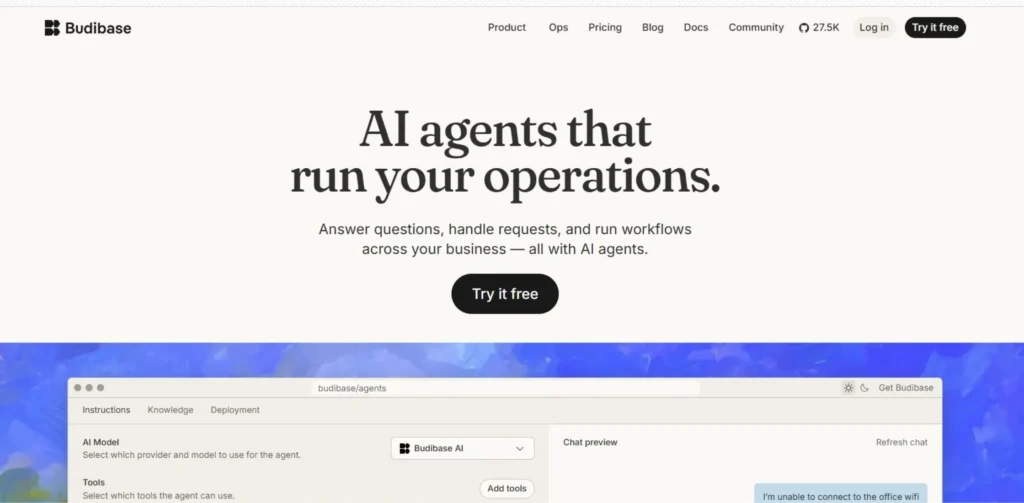
With a name that means Buddybase, Overview Budibase is a free open source collection of Rapid Web App Development Tools, a true self-hosted contender with high-price business offerings. It can be run on the self-hosted infrastructure of teams, or on the managed service. It is a visual app builder that supports custom code and it supports a variety of data sources such as MySQL, Postgres, MSSQL, Mongo and REST APIs. It is one of the best choices when data sovereignty and open-source adaptability are the most preferred qualities in a team.
Key Features
- Full open-source self-hosting
- 80+ data source connections
- Workflow automation with triggers & webhooks
- Role-based access control (RBAC)
Pros
- Zero vendor lock-in
- No additional cost security of the enterprise.
- Free self-hosting forever
Cons
- Infrastructure maintenance responsibility
- Smaller community vs. Retool
- Limited native mobile experience
Best For: Open-source internal tool builders
Pricing: Pricing Free self-hosted plan. Cloud Business plan of 50/month and 5 users.
Website: budibase.com
7. Microsoft Power Apps
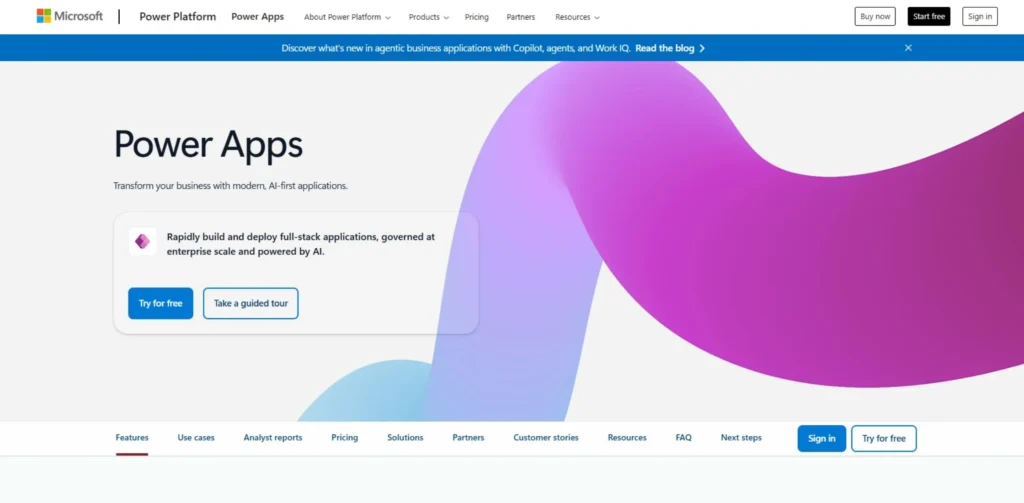
Power Apps Power apps will be the preferred alternative in Rapid Web App Development Tools when the organization is already on the Microsoft platform. Being natively integrated with Microsoft 365, Dynamics 365, Teams, and Azure, it makes it incredibly powerful with heavy Microsoft businesses. Power Apps cannot be properly integrated with Linux-based or non-Microsoft applications and has to be aware of the subtlety of the licensing. Its AI Copilot assists with developing applications with the text description in a few seconds.
Key Features
- extensive Microsoft 365 and Azure intertwining.
- Stable AI Copilot to create apps.
- These are integrations with dataverse (cloud database).
- Canvases and model-driven applications modes.
Pros
- Fits well in Microsoft-invested companies.
- AI Copilot removes time invested in development.
- Government compliance ready & FedRAMP.
Cons
- Complicated licensing system.
- Premium external Microsoft ecosystem.
- Little elasticity of non-Microsoft stacks.
Best For: Microsoft 365 enterprise organizations
Pricing: Per application plan- 5 dollars per user/month; Per user plan- 20 dollars per user/month.
Website: powerapps.microsoft.com
8. Appian
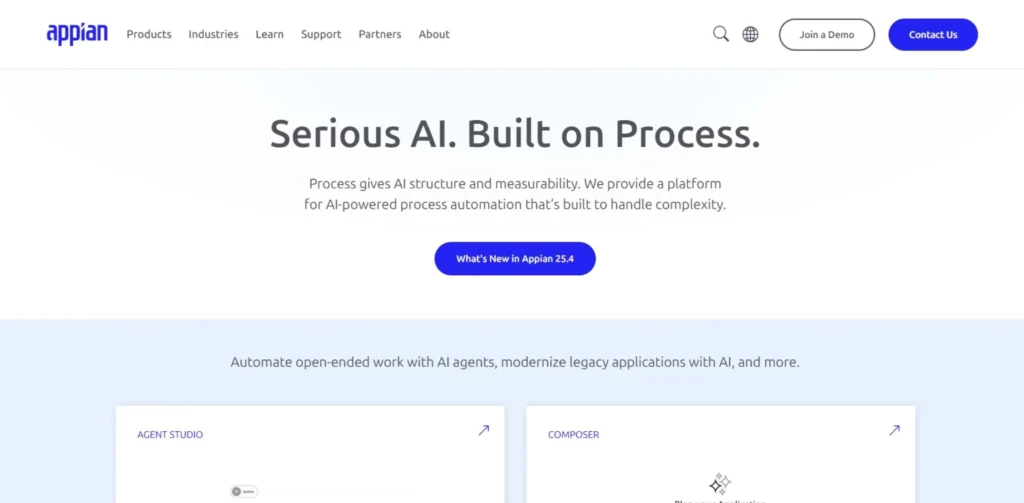
Appian is not like other Rapid Web App Development Tools since it is concerned with process construction rather than with construction of applications per se. Appian integrates business process automation, data manager and user interface design within a single environment where businesses can develop web and mobile applications quickly with concentrating on process automation and workflow management. It is the top essentials (regulated) industry sector in 2026 such as finance, healthcare, and government.
Key Features
- BPM End-to end process automation.
- Office work Modeling: Case management, document processing.
- FedRAMP High and HIPAA compliance
- Smart automation: AI Agent Studio.
Pros
- State of the art process automation.
- Well-developed regulatory compliance characteristics.
- Usable by business users, not very technical.
Cons
- Low adaptability of UI.
- Tedious learning curves of difficult workflow.
- Large data volumes Performance problems
Best For: Regulated industries & process-heavy enterprises
Pricing:Special pricing according to the application case; Standard, Advanced and Premium tier to be requested.
Website: appian.com
9. Zoho Creator
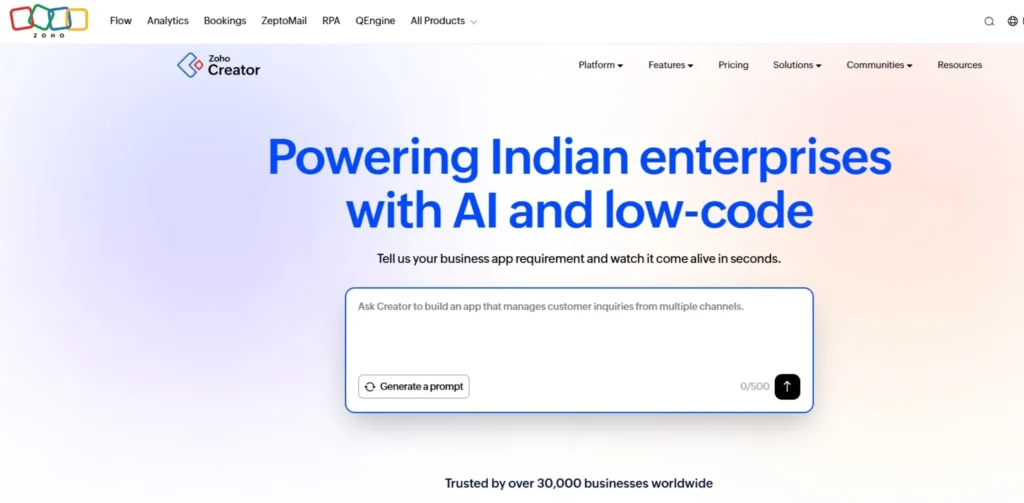
Zoho Creator is among the most balanced and inexpensive Rapid Web App Development Tools of small and medium businesses. Zoho creator is a low-code application development software which allows users to create their own business applications using a little programming knowledge. The software provides its creation of the device that gives opportunities to create forms, composing the workflow having one brain in the other, seeing the information, and seeking the information with other systems. Its CoCreator is an AI that makes the development process even faster.
Key Features
- Artificial Intelligence CoCreator of apps.
- Drag-and-drop workflow builder & form.
- Intraproperty platform deployment (web and mobile).
- Intense integration with Zoho ecosystem.
Pros
- Affordable pricing for SMBs
- Good Zoho ecosystem integrations.
- Unfriendly to developers, easy to use.
Cons
- One on one prices- increase with team size.
- Best in Zoho ecosystem.
- Restricted in extremely complex use.
Best For: SMBs within the Zoho ecosystem
Pricing: Standard $ 8/user/month Professional: 20/user/month Enterprise: 25/user/month (annually).
Website: zoho.com/creator
10. WaveMaker
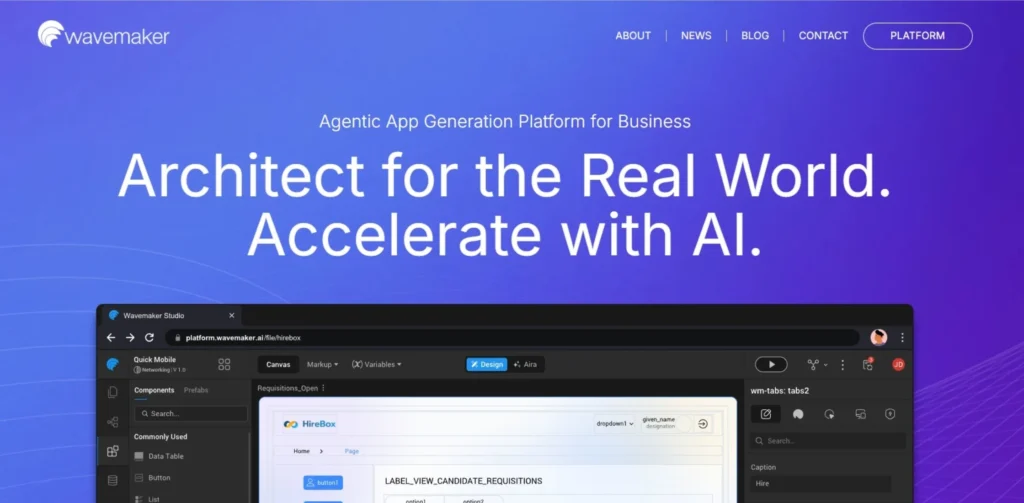
WaveMaker completes our list of best Rapid Web App Development Tools since it is a good option in developing an enterprise Web application with responsive design. WaveMaker provides a simplified development platform for businesses with web app development as their main priority, responsive design capabilities to make applications look and work on any device, and flexibility in deployment across on-premises or cloud platforms. It also possesses a community version, which is open-source.
Key Features
- Drag-and-drop UI development
- Reusable component library
- Premises and cloud-based modes of deployment.
- Connection of API and enterprise system.
Pros
- Powerful responsive design inbuilt.
- Elastic deployment (Cloud/on-premise).
- Community edition in open-source available.
Cons
- More complex join curve than easier devices.
- Less resources and smaller user base.
- Restricted specific mobile application.
Best For: Enterprise web app development teams
Pricing: Community (open-source) edition is a free version. Registration as an enterprise on request.
Website: wavemaker.com
Best Free Rapid Web App Development Tools
| Tool | Free Plan Details | Best For |
| Retool | Free for up to 5 users | Internal tools & dashboards |
| Bubble | Free plan with Bubble branding | No-code web apps |
| Mendix | Free with 2 environments | Enterprise prototyping |
| Lovable | Free for development & testing | AI-generated MVPs |
| Budibase | Free self-hosted plan forever | Open-source internal tools |
| Zoho Creator | Free trial available | SMB workflow apps |
Best Open Source & GitHub RAD Tools
| Tool | GitHub Integration | Self-Hosting | License |
| Budibase | Full GitHub sync | Docker-based | GPL-3.0 |
| WaveMaker | Git support | On-premise | Community Edition |
| Lovable | Two-way GitHub sync | Cloud only | Proprietary |
| Retool | Git sync (paid) | Self-hosted option | Proprietary |
| Appsmith | Full Git integration | Open-source | Apache 2.0 |
Best Rapid Development Platforms for Businesses — Quick Answer
| Business Type | Best Tool | Why |
| Startup / MVP | Lovable | AI builds apps in hours |
| Small Business | Zoho Creator | Affordable, easy to use |
| Mid-Market | Budibase / Retool | Flexible, cost-effective |
| Enterprise | OutSystems / Mendix | Scalable, compliant, robust |
| Microsoft Shop | Power Apps | Native M365 & Azure integration |
| Regulated Industry | Appian | FedRAMP, HIPAA, BPM-focused |
Key Features to Look for in RAD Tools
The six features are the most important when comparing Rapid Web App maker:
- Drag-and-Drop Builder: It must allow you to drag and drop the items on it so that even non-IT staff can create simple applications easily.
- Reusable Template and Components: Templates can be developed much faster and lower the number of duplications within a project.
- Integration Capabilities: It must be able to integrate databases, REST API and third-party integrations such as Stripe, Slack or Salesforce.
- Cross Platform Support: Much Rapid Web App Maker are expected to generate web and mobile apps that can interoperate without re-development.
- AI Help: code generation, debugging, stitching of apps, and similar, are not well-off features; they are no longer a nice-to-have but standard, and developed by AI, in 2026.
- Security & Governance: SOC 2 and HIPAA compliance certifications, Role-based access control, audit logs, SSO, and apps are necessary in business-tier applications.
How to Choose the Right Tool (Beginner to Enterprise)
The selection of the best Rapid Web App Development Tools would be based on your context. Here’s a practical guide:
- Evaluate the Technical Level of Your Team: Bubble or Lovable, being no-code tools, can be used by non-technical people; low-code tools are more suitable to technical teams that require customization, such as Retool or Mendix.
- Select App Type: To Retool, internal app makes sense; to Bubble or Lovable, it should be a customer facing app; to enterprise systems, which are process intensive apps, suited Appian or out Source.
- Think Your Budget: The team needs to be able to afford the RAD tools; not only in terms of licensing but also hosting, training and scaling. Check Integration Requirements: This is the part that should be integral to the platform integrating with your current tech stack -CRMs, ERPs, payment gateways, and databases.
- Avoid Vendor Lock-In: Get out of the vendor lock-in lock. Everything about your app depends on the goodwill of the vendor, so no, the vendor lock-in cannot be decreed away.
- Consider Scale: Select what can meet the needs of today, but do ensure that the platform has some capacity to expand as the users grow and the features become more complex.
Pros & Cons of Rapid Web App Development Tools
Pros:
- Strategically Accelerated Faster: Development Tools are fast, and standard web app development takes days, weeks and months to complete, which in turn enable business to enter the market much faster.
- Cost Saving: This is because having fewer, smaller developer teams saves on payroll and project costs, and therefore, app development is available to small organizations.
- Empowered Citizen Developers: Non-technical workforce will gain the ability to create their own workflow tools, which will allow them to reduce the IT backlog and keep their business nimble.
Cons:
- Vendor Lock-In: Most platforms are built on proprietary technology so to change a platform may need a rebuild of a new one.
- Technical Debt Risk: Trying to innovate and go fast might result in poor design and shortcuts, which require control at once, even with low-code tools, good governance and documentation practices must be implemented.
- Limited to Complex Logic: The RAD tools are not usually suited to complex algorithms, intensive computing, real-time data processing, or any task that requires manual control of the hardware.
Conclusion
In 2026, the future of the Rapid Web App Development Tools will be more intelligent, AI-enabled, and richer than ever before. No matter how non technological a founder would be and is planning on creating an MVP with Lovable, a developer would be looking to create internal dashboards using Retool or an enterprise architect would be trying to deploy mission critical systems using OutSystems or Mendix, there is a tool that would fit his or her preferences.
The point is to find the tool according to the level of skill of your team and its budget and complexity of use. With the trend of changing the nature of software creation still going on, adoption of the appropriate Rapid Web App Maker is not only a wise choice but also a competitive requirement.
FAQs
Rapid Web Applications? What are those?
Low-code or no-code tools Rapid Web App Development Tools enable developers and non-developers to create, debug and run web apps significantly faster than standard code development systems through drag-and-drop interfaces, provided templates and with the help of AI.
Which is the best Rapid Web App maker as a beginner?
The easiest to use are Bubble, Lovable, and Zoho Creator; they have an assortment of visual interfaces that require no prior background in code and can be used to assemble an operating web app in a matter of minutes.
Are there free rapid web app development tools?
Yes! No upfront investment is required and retool (up to 5 users) Bubble Mendix Lovable and Budibase (self-hosted) and Zoho Creator all have free plans or trials to start with.
Are Rapid Web App Maker intended to substitute traditional codes?
Not entirely. Although RAD tools are effective for business applications, dashboards, and workflows, they cannot be used for complex algorithms, high-performance computing, or applications that require complete custom code and hardware control.
What do you consider to be the best tool for rapid web app development at an enterprise level?
OutSystems and Mendix are then the best options for enterprises, which have enterprise-level security, compliance, scalability, and full application lifecycle support, but at a much higher price.