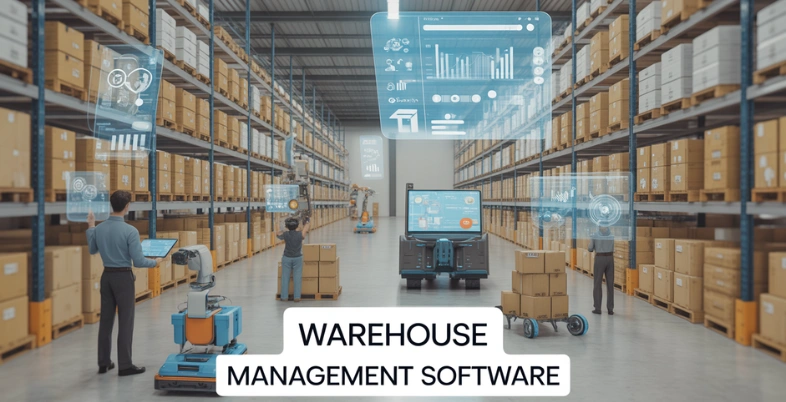
Warehouse Management Software (WMS) plays a crucial role in modern supply chain operations by helping businesses efficiently manage inventory, storage, and order fulfillment. As companies handle increasing volumes of goods and customer expectations rise, manual processes are no longer sufficient to ensure accuracy and speed.
A robust WMS provides real-time visibility into stock levels, tracks inventory movement, and automates key warehouse operations such as picking, packing, and shipping. This not only reduces errors but also improves productivity and operational efficiency.
Additionally, the Warehouse Management platform integrates seamlessly with other systems like ERP and eCommerce platforms, enabling better coordination across the supply chain. From small businesses to large enterprises, adopting the right WMS helps optimize warehouse space, reduce costs, and enhance overall customer satisfaction.
What is Warehouse Management Software?
Warehouse management software (WfMC) is a specialized computer program that is used to streamline and automate the daily activities that go on in a warehouse or distribution center, including goods receipt, inventory management, picking, packing, and shipping orders, as well as the handling of returns. It offers real-time visibility of inventory levels, stock locations, and movements with tools such as barcode scanning, RFID, and cycle counting, and connects with ERP, SCM, or e-commerce platforms to optimize business processes, minimize errors, minimize labour, and enhance overall productivity when businesses have to manage inventory on a large scale.
With a WMS, accurate fulfillment, improved resource distribution, and scalability to support the expanding operations are guaranteed through the implementation of such advanced functions, such as batch management, picking paths optimization, and demand forecast analytics.
Why Does Warehouse Management Platform Matter?
Warehouse management platform (WMS) is a necessity in maximizing warehouse functions, lowering expenses, and enhancing the efficiency in managing the inventory. It automates critical processes such as tracking of stocks and fulfilling orders, and thus is essential to businesses involved in supply or e-commerce.
Key Benefits
- Offers visibility of inventory in real-time to avert stockouts, overstocking, and discrepancies, which nearly always result in a more accurate inventory.
- Increases operational efficiency with automated picking, packing, and workflow optimization, and minimizes order turnaround time.
- Reduces expenses by reducing the number of labor requirements, wastage, and operating expenses, such as space usage.
- Improves the accuracy of orders and customer service using such tools as barcode scanning tools and increased delivery speed that provides same-day delivery.
- Facilitates the use of data to make decisions through performance analytics, demand, and inventory turnover analytics.
- Enhances scaling to deal with peak demand or business expansion without scaling-up errors or resources.
Essential Criteria For Evaluating Warehouse Management Software
The fundamental requirements needed to assess the Warehouse Management platform (WMS) center on functionality, scalability, and integration to suit the requirements of operation.
Core Functionalities
- Bin tracking and real-time visibility for multi-warehouse inventory management.
- Automation of order fulfillment, such as picking, packing, and shipping.
- Purchase order management, vendor integration, and returns management.
Scalability and Flexibility
- Capacity to manage increasing volume of orders, new warehouses, and various types of inventory such as perishables.
- Scaling can be easily deployed on clouds without a significant overhaul.
Integration Capabilities
- Integrated connectivity to ERP, e-commerce, and carriers to enable integrated data flow.
- Barcode scanning, RFID, and mobile warehouse process support.
- User Experience and Reporting.
- Easy interface and access to mobile to be efficient.
- Powerful performance insight, reporting, analytics, and forecasting tools.
Implementation Factors
- Easy access to vendors through training, customization, and cost transparency.
- Conformity with existing hardware, processes, and future business expansion.
List of 12 Best Warehouse Management Software
1. Oracle NetSuite WMS
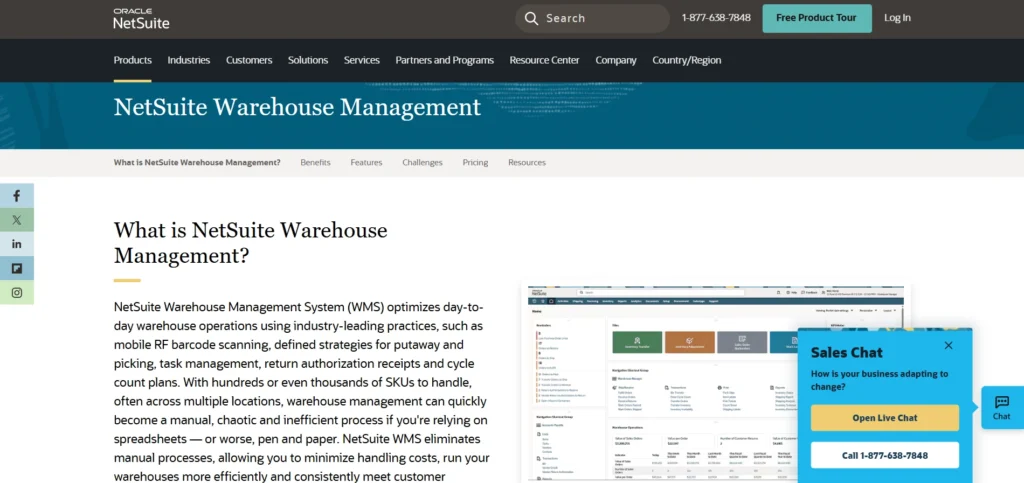
Oracle NetSuite WMS is a warehouse management system that is a part of the Oracle NetSuite ERP platform, which integrates warehouse management features into the structure of an e-commerce, manufacturing, and distribution business, and is a common system that grows with business expansion. It is a replacement of manual processes with mobile-first workflows through barcode scanning and real-time data synchronization of inventory, order fulfillment, financials, and CRM, which ensures full visibility of receiving goods to shipping and reduces errors, and contributes to its scalability without data silos.
Key Features
- Live inventory management and multi-point location, bin management, and cycle counts do not freeze transactions.
- Guided receiving, putaway, picking, packing, and shipping with optimized routing through mobile barcode scanning
- Inbound logistics include container tracking, landed cost capture, and receiving checks.
- Returns management, wave planning, and third-party carrier or automation system integration. Task automation.
- Smart Count and lot/serial number traceability of heavy compliance industries.
Pros:
- Cloud-based and very much integrated with NetSuite ERP, such that inventory, orders, finance, and CRM remain in a single system with real-time synchronization.
- Mobile/RF scanning, barcodes, and automated data capture in real-time inventory tracking.
- Enables wave and zone picking, putaway and picking policies, and bin control to make the warehouse more efficient.
- Smart Count / continuous cycle counting to enhance the accuracy of the inventory without a complete cessation of transactions.
- Fits well with small to mid-sized and developing corporations already using (or intending to use) NetSuite ERP.
- Cloud SaaS model also minimizes on-premise hardware, as well as providing automatic upgrades and online access.
- Users rate ease of use highly relative to cumbersome enterprise WMS and appreciate it being a part of NetSuite.
Cons:
- Needs NetSuite ERP; you can not normally purchase it as a pure standalone WMS, hence the overall project cost encompasses ERP.
- It does not have a feature depth as rich as top-tier enterprise WMS in terms of very complex, high-throughput, multi-site operations.
- Compared to specialist high-end WMS tools, labor management, advanced analytics, and automation (conveyors, robotics) are not so powerful.
- Implementation and maintenance cost is frequently increased with partner/consultant assistance that is necessary to customise the workflow.
- Otherwise, some scenarios might require separate mobile and scanning solutions or add-ons to become more complex.
- Similar to the majority of ERPs, deployments may also require months of process modification and user training.
Pricing
- NetSuite WMS does not have fixed rates but uses quote-based pricing depending on the size of the company, the number of users, volume of transactions, modules, and the length of the contract (usually a 1-5 year subscription), with prices depending on the company.
Website: https://www.netsuite.com/portal/products/erp/warehouse-fulfillment/wms.shtml
2. SAP Extended Warehouse Management (EWM)
Website: https://www.sap.com/products/scm/extended-warehouse-management.html
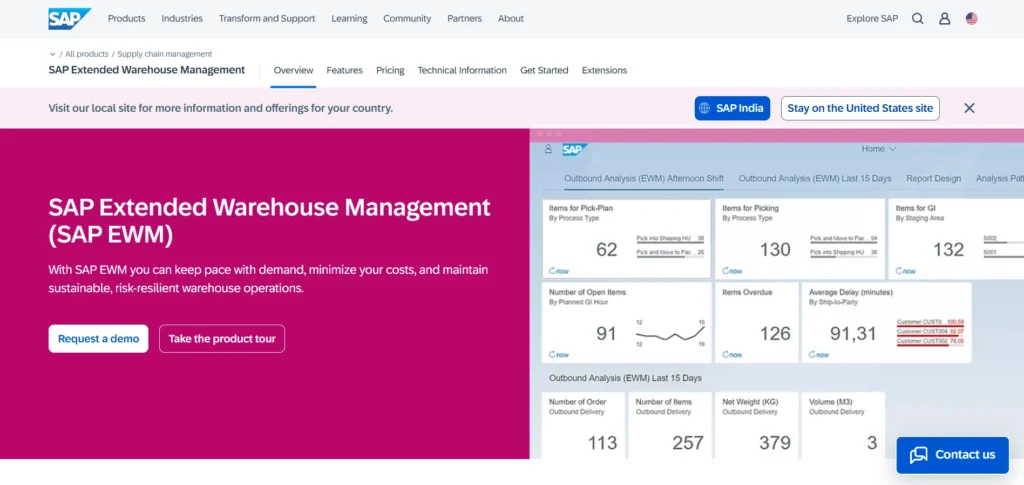
The SAP Extended Warehouse Management (EWM) is a full-fledged software package offered by SAP that enables optimization of high-volume warehouse management and integration with supply chain operations, such as inbound/outbound logistics, inventory management, and yard management. It delivers simple and complex warehouse configurations, deployable as part of SAP S/4HANA or as a standalone solution, and automation of such tasks as picking, packing, and returns processing as a means of increasing efficiency, accuracy, and scalability in manufacturing, retail, and distribution industries.
Key Features:
- Improved execution of the supply chain through alignment of operations within the warehouse with production, transportation, and yard logistics.
- Streamlined operations such as mixed pallet building, partial stock consolidation, labor tracking, and high-resource standards.
- E-commerce-specific returns-related retail tools, flexible multi-order picking, and a customer delivery change handling tool.
- Inbound/outbound processing and stock visibility, goods flow, RF system, and serial number control.
- Packing, labeling, VAS (value-added services), and hazardous goods. Value-added services such as packing, labeling, and handling of hazardous goods are per safety regs.
- Flexibility in deployment: basic/advanced in S/4HANA or decentralized on multi-site scalability.
Pros
- Embedded mode real-time data access with seamless integration with SAP S/4HANA.
- Very high scalability and flexibility in a decentralized mode of complex, high-volume operations.
- High-tech capabilities such as real-time inventory control, labor, and warehouse management.
- Accelerated order delivery, error minimization, and improved inventory precision for the U.S. enterprises.
Cons
- The embedded version constrains scalability and customization to highly complicated requirements.
- The decentralized structure is more complicated in terms of interfaces and is more technical.
- More expensive and more difficult to learn than a simpler system.
- Performance problems that may be experienced during embedded deployments under heavy loads.
Pricing
- SAP EWM follows a quote pricing model, which usually begins at about $1,000+ per month or year, depending on size, and implementation pricing costs vary according to the complexity of the warehouse, automation, and integrations, at $80,000 to $500,000.
3. Manhattan Active Warehouse Management
Website: https://www.manh.com/solutions/supply-chain-management-software/warehouse-management
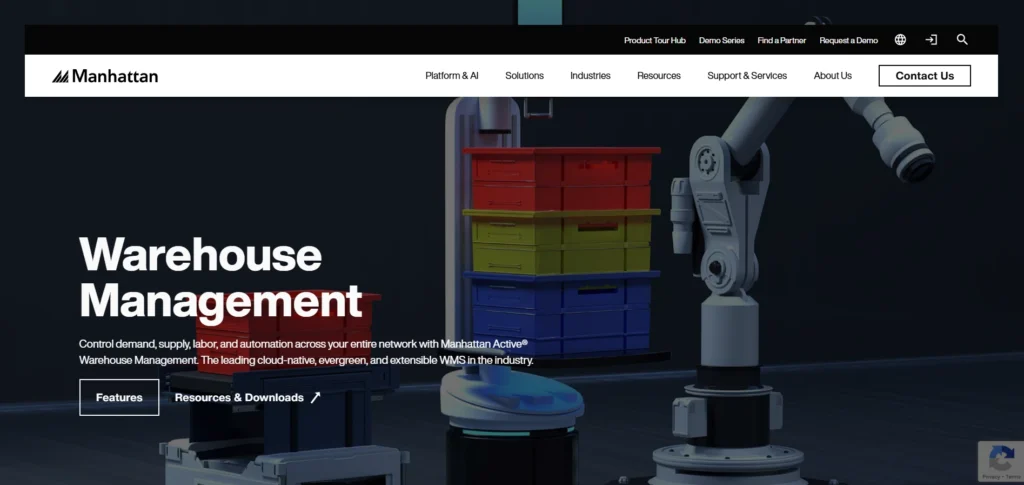
Manhattan Active Warehouse Management (MA-WM) is a warehouse management system (WfMC) with microservices, Manhattan associates, a cloud-native platform that is designed to be a unified and optimized warehouse, fulfillment, labor, slotting, and automation in one evergreen platform, eliminating traditional upgrades, and provides real-time visibility to solve contemporary distribution challenges such as omnichannel orders management and integrating warehouse automation.
Key Features
- Cloud-native architecture with constant feature updates without manual releases.
- Proof of one app to control the work of the warehouse, labor, and automation.
- Real-time prioritization and sequencing of orders with order streaming technology to reduce the time taken.
- Demand and product characteristics, intelligent slotting, and inventory optimization.
- Warehouse (WES) is built with robotics, conveyors, and sortation.
- Proactive decisions with global and facility-level visibility in real-time with digital twins.
- Extensive equipment such as barcoding, cross-docking, picking/packing, forecasting, and yard management.
Pros
- Gives instant access to inventory, orders, and operations, minimizing a reduction of stockouts and enhancing decision-making.
- Combines AI, machine learning, and robotics through its Warehouse Execution System (WES) to operate optimally in labor, slotting, and fulfillment.
- Provides high-volume warehouses with such advanced capabilities as cross-docking, cycle counting, omnichannel fulfillment, and automation.
- Scalable microservices architecture to be updated quarterly, without major upgrades, and with customization.
Cons
- Sophisticated implementation and a high learning curve, particularly when using non-technical users or at a smaller scale.
- High maintenance costs are anticipated to be incurred, and technical expertise would be needed to set up, maintain, and integrate.
- Not as intuitive an interface in certain modules, which may be annoying to use daily without intensive training.
- May will require more modules or customizations to be fully functional and extend the deployment.
Pricing
- Manhattan Active WM is not publicly priced and needs to be contacted by Manhattan Associates to be offered its own quote, which depends on the size of the deployment, the modules, and the needs of the enterprise; it tends to be a high-priced SaaS offering to large-scale operations.
4. Blue Yonder Warehouse Management
Website: https://blueyonder.com/solutions/warehouse-management
Blue Yonder Warehouse Management Blue Yonder Warehouse Management is a cloud-native warehouse management system (WMS) that optimizes the complex supply chain operations to offer real-time visibility, AI-driven coordination, and integrated operations between suppliers, carriers, and partners to achieve increased efficiency, flexibility, and decision-making under dynamic conditions, such as omnichannel retail, manufacturing, and logistics.
Key Features
- On-site inbound and outbound processing to provide an integrated store to supply network processing.
- Resource coordination of the working forces, AMRs (autonomous mobile robots), and quick delivery automation.
- Path optimization to reduce travel, optimize product flow, and maximize throughput.
- Real-time mobile workflows, configurable user experience, and intuitive to use in complex operations.
- End-to-end traceability, quality/expiration controls, and cycle counting of the inventory
- Picking, packing, and shipping support encompasses various approaches, cartonization, and carrier synchronization.
- Barcoding/RFID, order tracking, returns management, forecasting, and reporting/analytics.
- Cross-docking, kitting, receiving/put away, and workforce/labor management.
Pros
- Offers real-time inventory management to reduce discrepancies in inventories and enhance demand management.
- Promotes the automation of order fulfillment and the use of multiple channel processing to ensure quicker and more precise deliveries in e-commerce, retail, and marketplace.
- Permits custom workflows, integration with ERP/eCommerce (e.g., SAP, Shopify), and optimization of warehouse design to be more efficient.
- It also includes barcode/RFID support, task/labor optimization, and predictive analytics that can be used in scalable operations in complex environments.
- Provides enhanced reporting, mobile access, and AI-enhanced performance to make decisions based on data and perform learner processes.
Cons
- The interface may be clumsy and crowded, and may make navigation complicated for some teams.
- Complexity can be high, thus necessitating a lot of training and customization, and hence a steep learning curve.
- The implementation may be resourceful, particularly among non-enterprise users.
Pricing
- Blue Yonder Warehouse Management pricing is not publicly available and is generally scaled according to the scale of deployment, modules, and business requirements; the company should request a quote via Blue Yonder sales, since it can be accessed through subscription on platforms such as Microsoft AppSource.
Suggested Read
5. Infor WMS
website: https://www.infor.com/solutions/scm/warehouse-management-system
Infor WMS (Warehouse Management System) is a powerful, tier-1, cloud-based business solution created by Infor to streamline all warehouse operations, expedite supply channels, and create efficiency in any company regardless of size as it combines advanced inventory control, workforce management, task coordination and real-time analytics into a single platform that enables multi-site visibility, integration of automation and complex fulfillment requirements: B2B/B2C, 3PL billing and custom-made configurations.
Key Features
- Inventory control in real-time with license plate numbering (LPN) tracing, adjustable rotation policies, and multi-location control to reduce obsolescence and optimise inventory.
- Assigning sophisticated receiving and put-away operations such as docking, quality checks, cross-docking, voice/radio frequency/support, and mixed pallets.
- Workload balancing Workload balancing and cycle time reduction Automated workload picking, packing, and replenishment with dynamic picking, packing, and replenishing, wave/task management, and graphic queries.
- Automation system integration, E-commerce, RF/voice picking, yard management, shipping, returns processing, and 3PL-specific billing/invoicing.
Pros:
- Enables remote access and enhanced voice-enabled picking/packing to operate efficiently
- Integrates well with ERP systems such as Infor M3/LN, shipping agencies, and eCommerce systems.
- Facilitates management of multi-sites/3PL, inclusive of real-time inventory monitoring, 3D warehouse visualization, and FIFO/LIFO picking.
- Provides great ROI through automation, labor measurements, and workflow optimization, such as wave/task management.
Cons:
- Its high cost of implementation and complexity render it not the best option for small businesses.
- The user interface may seem complicated, and it needs IT skills to do integrations and troubleshoot.
- There can be problems with ERP synchronization that require the assistance of the vendor and result in delays.
Pricing:
- Infor WMS pricing is not publicly determined, and it usually begins with a tailor-made quote depending on deployment (cloud or on-premise), users, warehouse size, modules, and integrations, which are often between $100-300 per user/month with a cloud subscription or more with an enterprise license.
6. Fishbowl Warehouse

Website:https://www.fishbowlinventory.com/
The Fishbowl Warehouse Management platform is a scalable powerhouse software with big capabilities to be used by small to medium manufacturers, distributors, wholesale, and e-commerce companies to streamline the inventory management process, order fulfillment process, and the manufacturing process. It is also known as Fishbowl Warehouse Management software or Fishbowl Advance,d or Fishbowl Inventory with warehouse modules. It integrates the physical strength of on-premise with cloud-based web browser and mobile application access, allowing real-time bar-code scanning.
Key Features
- Real-time tracking of inventory in more than 2 locations with support of barcodes/serial/lot numbers and scanning on a mobile phone to receive, putaway, pick, and count cycles.
- Order management such as sales/purchase orders, invoicing, kitting, fulfillment, shipping, returns, and automated EDI/e-commerce syncing.
- Production of tools such as BOMs, work orders, MRP, labor tracking, production scheduling, and cost reporting.
- AI-powered forecasting, demand, custom dashboards, and exception alerts. Reporting and analytics.
- QuickBooks, Xero, 3PL, and CRM/ERP integrations, third-party functionality extensions.
- Pick/pack workflows, staging, workforce management, and real-time visibility are warehouse optimization capabilities that are able to reduce stockouts and overstock.
Pros:
- Offers powerful warehouse capabilities such as barcode scanning, picking/packing operations, multi-warehouse support, and cycle counting to achieve efficient operations.
- Provides live inventory tracking, part re-order, and connections with e-commerce (e.g., Shopify, Amazon) and shipping companies (e.g., FedEx, UPS).
- Superior customer service and responsive customer care, training, and implementation assistance during installation.
Cons:
- Expensive initial or subscription fees relative to certain competitors, and possible add-ons for more advanced functionality.
- Outdated interface, high learning curve, and some bugs in shipping or reporting that can only be worked around.
- Poorly customized, on-premise in earlier versions, and mixed experiences with sophisticated reporting or automatic planning.
Pricing
- Essentials:$229 USD/mo. billed annually
- Growth:$429 USD/mo. billed annually
- Scale:$729 USD/mo. billed annually
- Advanced: Custom
7. Logiwa WMS
Website:https://www.logiwa.com
Logiwa WMS is a scalable warehouse management system that mainly Cater multiple warehouses with high volume eCommerce, direct-to-consumer (DTC), B2B, and 3PL operations, where a business can automate and optimize inventory management, order fulfillment, picking, packing, shipping, and real-time tracking without the required additional personnel.
It has a modern, headless architecture through Logiwa IO (announced in 2023), which includes AI-driven demand prediction, task automation, workflow personalization, and integrates well with more than 240 platforms such as Shopify, Amazon, Magento, Walmart, and carriers such as UPS to process orders properly and multi-channel.
Key Features
- Multi-location warehousing inventory controls, responsive picking areas and instant shortage location.
- Mobile order picking/cluster picking, scanning, and real-time job tracking/ bunching applications.
- AI-based optimization of the routing, packing, demand forecasting, and exception management.
- Inbuilt support of 240+ eCommerce solutions, marketplaces, transportation, and accounting software.
- Real-time inventory, order and productivity reports, dashboards, and analytics.
- Barcoding/serial tracking, receiving/putaway, purchasing, workforce management, and returns/recall.Workflow customization, 3PL customer portals, and high-volume, high-volume automation.
Pros:
- Provides complete warehouse services, which include bar code scanning, picking/packing services, multi-warehouse support, and cycle counting in order to facilitate effective operation.
- Offers real-time inventory, automatic reordering, and contact to e-commerce solutions (e.g., Shopify, Amazon), shipping carriers (e.g., FedEx, UPS).
- Friendly customer services, responsive services, training resources, and particular assistance in the set-up.
Cons:
- High start-up or monthly rates compared to other rivals, and perhaps more in the meantime to be featured.
- Sluggish or old user interface, steep learning curve, and shipping or reporting bugs, occasionally requiring manual workaround.
- Limited customization, on-premise in the older models, and ambivalent experience in the high-level reporting or automatic planning.
Pricing:
- Logiwa WMS is not publicly traded and requires a sales contact to obtain a custom quote, based on business size, order volume, and functionality, which is frequently in the form of SaaS subscriptions.
8. SkuVault
website: skuvault.com
To expand with e-commerce and other omnichannel companies and other sales channels, SkuVault Core (formerly SkuVault) is an inventory management platform and a cloud-based warehouse management system (WMS) used as the main provider of fulfillment operations in several different sales channels, including Amazon, eBay, Shopify, and others. It has scheduled real-time stock alignment to prevent overselling and stockouts, automates the picking and packing operations with digital picklists, barcode scans, and an efficient delivery system, and has quality control to detect any mistakes early before dispatch.
Key Features
- Live inventory synchronization of marketplaces, warehouses, and sales channels.
- Optimization of picking routes and minimization of errors through barcode scanning and digital picklists.
- Zone warehouse organization, bins, stock transfer, multi-location.
- Quality control instruments to assess the errors in fulfillment before shipment.
- Bundling, kitting, and management of kit assembly.
- Order management, order forecasting, purchase orders, and receiving/putaway.
- Supplier management, reporting/ analytics, and alerts/ notifications.
- Integrations with online stores (e.g., Amazon, Shopify, QuickBooks).
- Cycle counting, returns management, and workforce/load management.
Pros:
- Inventory monitoring in various warehouses in real time, which prevents overselling and stockouts.
- Container-based and multi-location inventory is supported, which is helpful in large or intricate warehouses.
- Good picking, packing, QC, reordering, and replenishment workflow, barcode-scanner support.
- In-built connections with e-commerce ( Shopify, Amazon, etc. ) and shipping organizations.
- Well-developed API and integration ecosystem, which allows it to be more easily connected to 3rd -party tools.
- Positive reputation of customer-support when onboarding and in use.
Cons:
- User interface may be inconsistent and even outdated; different screens have different user interfaces, and can be confusing to users.
- Average learning curve, particularly among non-technical warehouse personnel; some users have noted that there is not enough training material.
- Periodic glitches or slowdowns in performance during heavy volume times or during peak seasons.
- The level of customization and complex workflow is less than the enterprise level WMS such as SAP or Oracle.
- Other users report on the existence of undocumented connector/integration-related charges based on the number of marketplaces/ERPs being connected.
Pricing:
- The pricing begins at approximately $350 a month but can be tailored to order volume, warehouses, and add-ons. Request sales to be quoted, because it can be scaled to the needs of e-commerce.
9. Extensiv (formerly 3PL Central)
website: https://www.extensiv.com
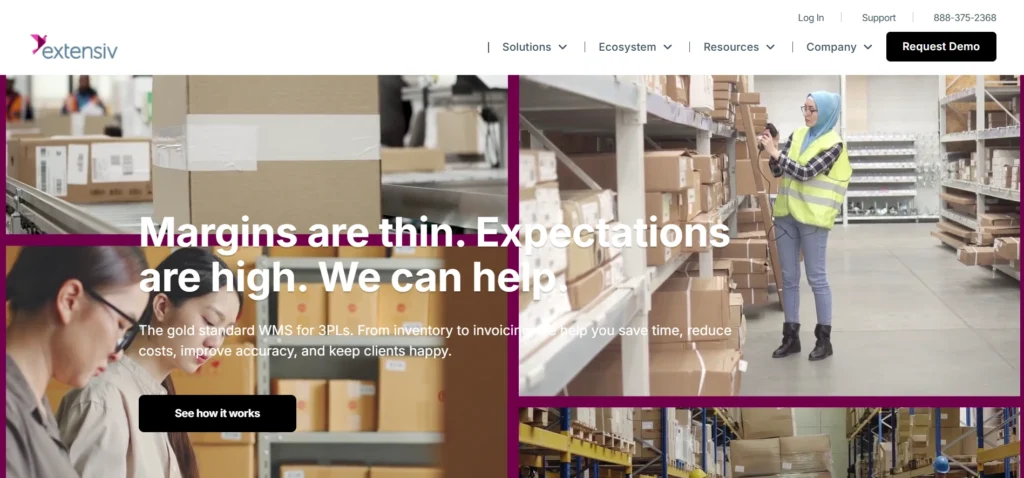
One of the cloud based warehouse management systems (WMS) is Extensiv, or 3PL Central and is specifically designed to meet the needs of the third-party logistics (3PL) providers who require efficient inventory management, the automation of time-consuming operations, like picking, packing, and shipping, as well as provide real time visibility to multiple customers in the warehouses and all this in addition to seamlessly integrating with e-commerce providers, ERP, shipping carriers, and other supply chain applications to eliminate errors and reduce labor by at least a quarter to half and make inventory correct.
Key Features
- Barcoding, serial/lot/batch management, as well as product rotation to shelf life, with real-time tracking of inventory.
- Multi-client and multi-warehouse management of 3PLs who work with various operations.
- Automated order filling, receiving/putaway, picking/packing, shipping, and returns handling.
- Powerful reporting/ analytics, billing/ invoicing, and workforce/ load management.
- API to shopping cart, CRM, ERP, TMS, and third-party API, e.g., wireless warehouse tool.
- Kitting, staging, purchasing, and hazardous materials support have been directed to putaway.
Pros:
- Provides cloud support to be able to track the transactions easily and see inventory in real-time in more than one location.
- Provides barcode scanning, tracking lot-wise, and integrations with accounting packages such as QuickBooks to facilitate inbound/outbound processes.
- Scales to support growth with optional capabilities such as dock scheduling, automated workflow, and reporting that ensure that 3PLs increase orders by 20-28 per cent within the first year.
Cons:
- Lacks has full ERP capabilities, and this means that it needs other systems to manage business in a comprehensive manner beyond what it does in the warehouses.
- May has a learning curve of intricate custom working processes, even with easy onboarding.
- Small operations may find it difficult to add up in terms of pricing and advanced features, as the smaller operations do not have clear, modular options published easily.
Pricing:
- It begins at $599/month, depending on the size of the warehouse, volume of orders, and bespoke requirements. Call sales to get a quote.
10. Microsoft Dynamics 365 Supply Chain Management (WMS)
Website: https://learn.microsoft.com/en-us/dynamics365/supply-chain/warehousing/warehouse-management-overview
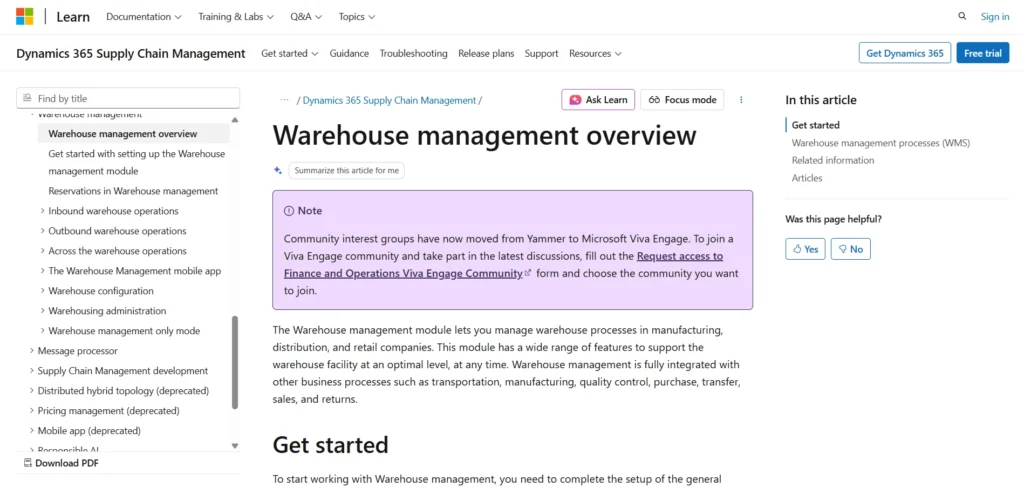
The Microsoft Dynamics 365 Supply Chain Management solution has a powerful Warehouse management system(WMS) that optimizes warehouse management software operations in manufacturing, distribution, and retail business by giving advanced control over the processes inbound and outbound, as well as tracking inventory and connecting it to other supply chain functions, including manufacturing, transportation, procurement, sales, and quality control. It is a cloud-based ERP, which is flexible to query-based workflows; supports full location stocking limits and volumetrics, real-time capabilities to see goods movements, and mobile execution of tasks such as picking, put-away, and counting of serial numbers.
Key Features
- In-built support of source documents such as sales orders, returns, transfer orders, production orders, and kanban.
- Elastic inbound/outbound material processes whose query-based setup allows put-away, picking, and replenishment (e.g., Min-Max, FIFO/FEFO/LIFO strategies).
- State-of-the-art warehouse design which controls location volumetrics, zones, fixed storage, and automated item/location identification through barcodes.
- Inventory tracking in real time, status (available, quarantine), cycle counting (manual, threshold, spot), and complete physical inventories based on ABC analysis.
- The automated labeling of goods, quality checks, optimization of loading, creation of documents, and carrier integration (e.g., FedEx, UPS).
- Cross-docking (pure, transshipment, manufacturing) and rule-based activation and mobile execution.
- Incorporation of quality control and sampling regulations, quarantine zones, and triggers when receiving, packing, or shipping.
- Such types of replenishment as wave demand, load demand, immediate, mobile app assistance, and picking route optimization.
- Compliance and traceability weight tracking, batch, serial, and variable weight tracking.
- Mobile warehouse, printing equipment services, and performance insights analytics/reports.
Pros:
- Extensive integration in the broader Dynamics 365 and Microsoft ecosystem (Finance, Sales, Power BI, Power Apps, Office, Azure), which lessens silos and increases ease of data sharing between departments.
- Good multi- warehouse, multi-location services with complete traceability with batch and serial numbers, which are suitable in complicated distribution networks.
- Enhanced warehouse processes (wave picking, cross-docking, cycle counting, mobile-based pick/pack/ship, replenishment rules) of sophisticated warehouse operation
Cons:
- It may be lengthy and complicated (many times months long) to implement, particularly in situations where advanced WMS capabilities need to be implemented in more than one location.
- The cost of ownership may be so high because of licensing, implementation services, hardware required (scanners, label printers, rugged devices), and support.
- The third-party integration with certain third-party systems and dedicated logistics may incur additional development and middleware, which complicates it.
Pricing:
- Prices of Dynamics 365 Supply Chain Management are by subscription, beginning around $180/user/month with full access (including WMS), but prices depend on licensing level, number of users, deployment (cloud/SaaS), add-ons, and partner discounts; specific quotes will have to be negotiated with Microsoft or a partner since it is not publicly traded at specific prices.
11. Körber WMS (formerly HighJump)
Website: https://koerber-supplychain.com/supply-chain-solutions/supply-chain-software/warehouse-management/
Körber WMS, formerly HighJump Warehouse Management System (WMS), is a highly customizable, scalable, and mobile-based warehouse management software platform by design to optimize supply chain operations of businesses of all sizes (especially those in e-commerce, manufacturing, and distribution industries).
Recently purchased by Körber Supply Chain of 3M, it became Korber K.Motion WMS (also known as Warehouse Edge), a modular process-based platform that is integrated with ERP systems, materials handling equipment, e-commerce platforms, such as Shopify and Amazon, among other tools in the Körber Supply Chain Advantage.
Key Features
- Inventory monitoring in different locations, automated refill, and inventory control to avoid stockout or overstocking.
- streamlined order management, processing, fulfillment, returns, exchange, and real-time status updates.
- Shipment tracking, the selection of optimal carriers, barcode/ticket scan, and shipping system integration.
- Developed reporting, data analytics, performance monitoring, and supply chain intelligence KPIs.
Pros:
- Very customizable and suitable for individual requirements of operation.
- Excellent integrations with the ERP, EDI, eCommerce, accounting, and shipping systems.
- Multi-site scalable, real-time inventory visibility, barcode/RFID, and analytics.
- Facilitates such advanced functionalities as dynamic slotting, task interleaving, and mobile access.
Cons:
- Sharp learning curve; not user-friendly with extensive training (e.g., 3 weeks to CSRs).
- Unfriendly interface that is likely to increase the time taken in operations such as orders and receipts, which are cost-additional.
- Weak report customization, complex integrations with 3rd parties, and lack of backorder notifications.
- Difficult implementation, less user-friendly interface, and possible problems with highly complicated logistics.
Pricing
- Körber WMS pricing is not available publicly and is tailored according to business scale, options chosen, type of deployment (cloud or on-premise), and number of users; it typically falls within the enterprise category, beginning at tens of thousands per year, and quote requests can be made through demos.
12. ShipHero WMS
Website:shiphero.com
ShipHero WMS is an e-commerce brand and direct-to-consumer (DTC) seller oriented cloud Warehouse management system, which optimizes inventory management, order fulfillment, picking, packing, shipping, and returns at one or more warehouses, offers real-time visibility, automation rules, on-the-go operations with a mobile application, optimized integrations with other systems such as Shopify, Amazon, eBay, Walmart, and carriers such as FedEx, UPS, and USPS, advanced AI.
Key Features
- Inventory management, tracking, kitting, product turnover, and multi-warehouse.The order and shipping system will include barcoding, picking/packing, returns, live carrier rates, and automatic labeling.
- COGS analytics and reporting, picker efficiency, replenishment, and insights customization. AI selection of the optimal routes, batching, and minimal traveling time.
- Anywhere Mobile inventory/shipping inventory app, and wireless warehouse/workforce management.
- E-commerce integration (Shopify, Amazon) and carrier integration (FedEx, UPS).
Pros
- Best mobile picking by route instruction saves on travel time and errors within the warehouse.
- Live inventory monitoring across locations, such as cycle counts and reorder warnings, enhances precision.
- Easy connections with such platforms as Shopify, Amazon, or WooCommerce facilitate ordering.
- Manual work and idle time are reduced through returns, shipping rule and labor tasking automation.
- The flat-rate fulfillment price helps to predict costs in the case of small operations.
Cons:
- The minimal level of customization obstructs the assimilation into distinct 3PL workflows or automations.
- Simple reporting is not rich in advanced analytics other than basic measures.
- Smaller users are inhibited by high minimum order volumes and a small number of warehouse networks.
- Other users complain of interface problems and unresponsive customer service.
- Complicated international or edge cases may slow down their onboarding.
Pricing:
- ShipHero WMS charges are tailor-made, depending on the size of the business, volume of orders, and features, and plans can be offered to enterprises; they do not have any set public plans listed.
Comparison Table
| Software | Best For | Key Strengths | Integrations | Pricing Model |
|---|---|---|---|---|
| Oracle NetSuite WMS | Growing businesses using ERP | Real-time inventory, ERP integration | Strong (NetSuite ecosystem) | Quote-based |
| SAP Extended Warehouse Management | Large enterprises | Advanced automation, scalability | Excellent (SAP ecosystem) | Quote-based |
| Manhattan Active WM | High-volume warehouses | AI-driven optimization, automation | Extensive | Quote-based |
| Blue Yonder WMS | Retail & supply chain | AI-powered insights, real-time visibility | Strong | Quote-based |
| Infor WMS | Enterprises & 3PL | Workforce management, 3D visualization | Strong | Quote-based |
| Fishbowl Warehouse | Small to mid businesses | Inventory tracking, QuickBooks integration | Moderate | Starts ~$229/month |
| Logiwa WMS | eCommerce & DTC brands | AI forecasting, automation | 240+ integrations | Quote-based |
| SkuVault | Omnichannel retailers | Inventory sync, quality control | Strong | Starts ~$350/month |
| Extensiv (3PL Central) | 3PL providers | Multi-client support, billing tools | Strong | Starts ~$599/month |
| Microsoft Dynamics 365 WMS | Enterprises using Microsoft | Deep ecosystem integration, analytics | Excellent | Starts ~$180/user/month |
| Körber WMS | Custom enterprise needs | High customization, scalability | Strong | Quote-based |
| ShipHero WMS | eCommerce fulfillment | Mobile-first, automation rules | Strong | Quote-based |
Conclusion
Depending on the size of the business, scalability, integrations, and budget, the presence of enterprise-level warehouse management software, including the Oracle NetSuite WMS, is good for complex automation and analytics, but the inexpensive solutions, such as Fishbowl, may be used by SMBs with extensive inventory tracking and e-commerce integration requirements.
With these solutions, even the most unorganized warehouses are transformed into highly organized facilities so that they can be viewed in real time, have better pickups and packs, reduce mistakes, and save money that would have been used in delays or dissatisfied customers, either at a small store or a large distribution centre. Select the ideal fit that grows with you, depending on the volume, multi-site support, and displays.
FAQs
Q.1 Why Do Businesses Need WMS?
WMS removes manual errors, has real-time inventory management, and accelerates the fulfillment of eCommerce, 3PLs, and distributors.
It facilitates expansion into others as the business grows, reduces expenses on inventory variances, and manpower.
Q.2 What Are Key WMS Features?
The key characteristics are barcode scanning, FIFO /FEFO inventory practices, auto-replacement, mobile workflows, and BI reporting.
Other, more advanced features, such as voice picking, slotting rules, and lot/serial tracking, are typically found in the best tools.
Q.3What Is The Cost Of WMS?
Pricing: entry cloud WMS systems begin at $50 to $200/user/month, and enterprise cloud WMS software, such as SAP, can be higher than 10K/month in addition to installation costs.
They are based on the size of the warehouse, users, and customizations; most of them provide freemium trials.
Q.4 How To Choose The Best WMS?
Evaluate requirements such as volume of orders, integrations, and scalability; demonstrate 3-5 options and review user comments.
Focus on adaptable, mobile-friendly solutions with established payback in your industry (e.g., eCommerce vs. manufacturing).
Q.5 What Are The Advantages Of WMS?
It has a pick accuracy of 99 100% and can cut fulfillment time by 20-50 percent, and smart slotting enables better utilization of space.
Live intelligence improves decision-making and customer satisfaction.
Q.6 How Long To Implement WMS?
Cloud installation requires 1-3 months, more (6-12 months) when integrating with more complicated ERP systems such as SAP.
Migration of data, training of staff, and support by vendors are determinants of success.